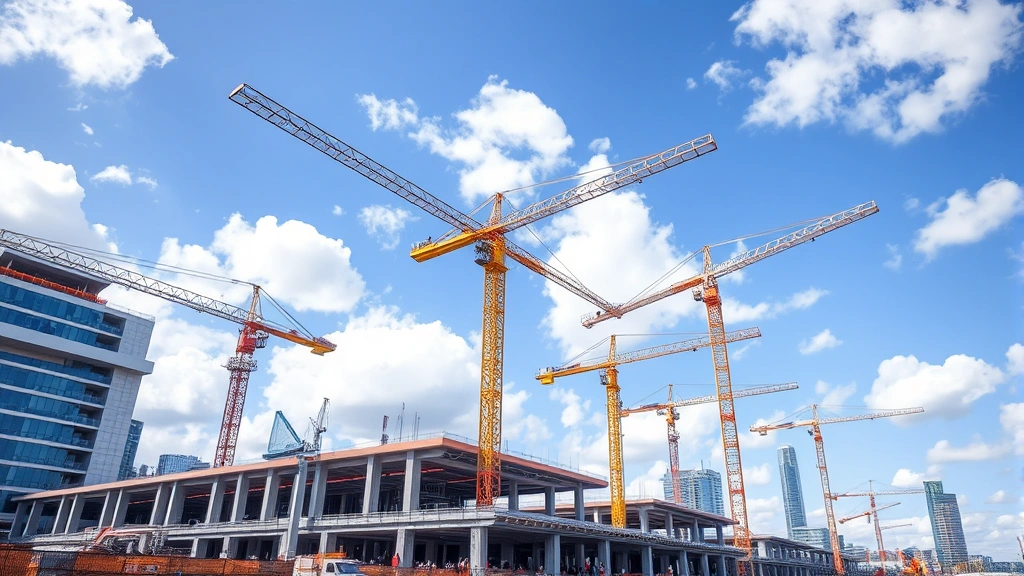
Impact of Built Environment on Economy: Expert Insights
The built environment—comprising infrastructure, buildings, transportation networks, and urban systems—represents one of the most significant economic forces shaping modern societies. This interconnected web of human-constructed spaces generates trillions in economic value while simultaneously influencing productivity, labor markets, real estate dynamics, and resource consumption patterns. Understanding the economic implications of built environment decisions is critical for policymakers, economists, and environmental strategists seeking to balance growth with sustainability.
The relationship between constructed infrastructure and economic performance extends far beyond simple real estate valuations. It encompasses how cities are organized, how people move through spaces, how businesses operate, and how resources are allocated across regions. Recent research from leading economic institutions demonstrates that the quality, design, and sustainability of built environments directly correlate with GDP growth, employment rates, and long-term economic resilience. As climate pressures intensify and urbanization accelerates, the economic stakes of built environment decisions have never been higher.
Defining the Built Environment and Its Economic Scope
The built environment encompasses all human-made structures and infrastructure that shape how communities function economically. This includes residential buildings, commercial districts, industrial facilities, transportation networks, utilities, public spaces, and institutional structures. When discussing what is building environment from an economic perspective, analysts must consider both tangible assets and the systemic relationships they create.
Economic value in the built environment manifests across multiple dimensions. First, there is direct asset value—the worth of buildings and infrastructure themselves. Second, there are productivity gains derived from efficient spatial organization and accessibility. Third, there are multiplier effects where infrastructure investments stimulate broader economic activity through employment, supply chains, and consumer spending. The World Bank estimates that infrastructure accounts for approximately 40-50% of global wealth in developed economies, making built environment quality a fundamental determinant of national prosperity.
Understanding what are human-environment interactions within built contexts reveals how economic systems depend on environmental carrying capacity. The built environment represents humanity’s largest intervention in natural systems, covering approximately 1% of Earth’s land surface but consuming 75% of natural resources. This paradox—minimal spatial footprint but massive resource consumption—drives much of contemporary ecological economics discourse.
Infrastructure Investment and GDP Growth
Infrastructure spending represents one of the most direct mechanisms through which built environment decisions impact economic output. Empirical research consistently demonstrates positive correlations between infrastructure quality and GDP growth rates. A World Bank analysis found that a one percent increase in infrastructure stock correlates with approximately 0.08% increase in GDP growth in developing economies, with effects potentially reaching 0.15% in mature economies.
The mechanisms underlying this relationship operate through several channels. Quality infrastructure reduces transaction costs for businesses, enabling faster commerce and lower supply chain expenses. Reliable transportation networks expand market access, allowing firms to reach broader customer bases and source inputs more efficiently. Communication infrastructure facilitates knowledge transfer and digital economy participation. Energy infrastructure ensures reliable power supply critical for modern manufacturing and services. Water and sanitation systems reduce disease burden, improving workforce health and productivity.
However, infrastructure returns vary significantly based on design and maintenance quality. Poorly planned infrastructure can generate negative returns, consuming capital without generating proportionate economic benefits. The phenomenon of “white elephant” projects—expensive infrastructure with minimal utilization—demonstrates that mere construction volume does not guarantee economic value creation. Optimal infrastructure planning requires sophisticated cost-benefit analysis, demand forecasting, and integration with broader economic development strategies.
Construction sector employment represents another major economic channel. Infrastructure projects directly employ millions globally—from engineers and architects to laborers and equipment operators. In the United States, construction represents approximately 4% of GDP and 5.5% of employment. During economic downturns, infrastructure investment serves as countercyclical stimulus, maintaining employment and demand. Conversely, infrastructure underinvestment creates bottlenecks that constrain economic growth potential, a phenomenon increasingly evident in aging developed-world infrastructure systems.
Real Estate Markets and Wealth Creation
Real estate represents the largest asset class globally, with estimated values exceeding $300 trillion. Built environment quality fundamentally shapes real estate valuations, with location-specific factors—accessibility, amenities, environmental quality, and development patterns—creating vast price differentials. Understanding human-environment interaction dynamics helps explain why identical structures command dramatically different prices across locations.
Urban land prices demonstrate extreme variation based on built environment characteristics. Prime commercial real estate in Manhattan commands values exceeding $3,000 per square foot, while equivalent space in declining industrial cities might cost under $100 per square foot. These differentials reflect accumulated infrastructure investments, density patterns, regulatory frameworks, and perceived economic opportunity. Real estate wealth effects significantly influence household balance sheets—residential property represents 60-70% of household wealth in developed economies, making built environment conditions central to wealth inequality patterns.
The real estate sector generates substantial economic activity beyond direct property transactions. Property management, maintenance, renovation, and improvement services constitute significant employment and GDP components. Mortgage lending drives financial sector activity. Property taxation funds municipal services. Real estate speculation and development cycles influence broader economic volatility. The 2008 financial crisis demonstrated how built environment asset bubbles can trigger systemic economic collapse, illustrating the macroeconomic significance of real estate market dynamics.
However, real estate-driven economies create distortions. Excessive speculative investment in property diverts capital from productive sectors. Housing affordability crises emerge when real estate appreciation outpaces wage growth, reducing economic efficiency and social cohesion. Vacant speculation properties represent deadweight economic loss while contributing to urban blight. These dynamics highlight how built environment economics can generate both wealth creation and economic dysfunction depending on policy frameworks and market structures.
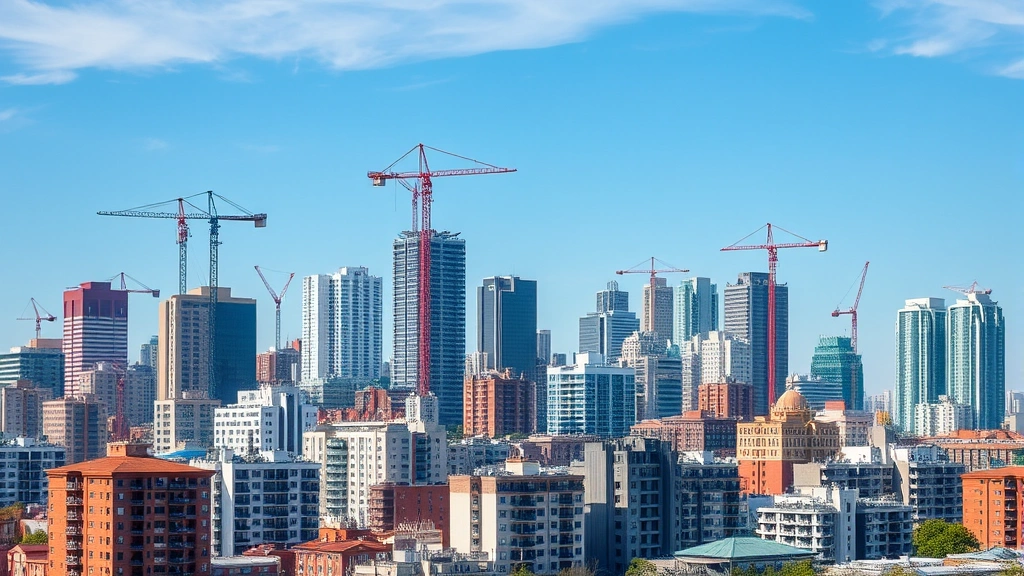
” alt=”Urban skyline with mixed residential and commercial buildings under construction, modern cranes, blue sky, bustling economic activity”>
Labor Productivity and Urban Design
Urban design fundamentally influences worker productivity through multiple mechanisms. Dense, mixed-use development patterns facilitate knowledge spillovers—workers encounter diverse ideas, expertise, and perspectives, stimulating innovation and skill development. Agglomeration economies emerge when related industries concentrate geographically, creating specialized labor markets and supplier ecosystems. Silicon Valley’s technology cluster, London’s financial district, and Hollywood’s entertainment industry exemplify how built environment density generates economic agglomeration effects.
Commute times represent substantial productivity losses. The average American spends approximately 54 minutes daily commuting, representing roughly 250 hours annually. This time represents pure deadweight loss from economic productivity perspective, while generating stress, health problems, and reduced work-life quality. Built environment designs emphasizing transit-oriented development, mixed-use neighborhoods, and remote work infrastructure can recapture this lost productivity. Studies suggest that reducing commute times by 30 minutes daily could increase annual productivity equivalent to 1-2% GDP in developed economies.
Office environment design directly impacts worker performance. Natural lighting, air quality, ergonomic design, and access to green space demonstrate quantifiable productivity improvements. Companies investing in high-quality office environments report 5-15% productivity gains and 20-30% reductions in absenteeism. These benefits extend beyond individual workers—collaborative office designs enhance team performance and innovation rates. The built environment thus functions as productive capital, with design quality directly translating to economic output.
Remote work emergence during pandemic lockdowns revealed that physical built environment proximity may be less critical for many knowledge workers than previously assumed. However, this shift created new built environment demands—home office space, reliable internet infrastructure, neighborhood amenities supporting work-from-home lifestyles. The long-term equilibrium likely involves hybrid work patterns requiring diversified built environment configurations rather than traditional concentrated office districts.
Transportation Systems and Economic Efficiency
Transportation infrastructure represents critical built environment components with profound economic implications. Efficient transportation systems reduce goods movement costs, expand market access, and facilitate labor mobility. Historical analysis reveals that railroad development in the 19th century and interstate highway systems in the 20th century generated massive economic agglomeration and growth. Contemporary logistics and supply chain efficiency depend entirely on transportation infrastructure quality.
Congestion costs represent enormous economic drains. The Texas A&M Transportation Institute estimates that traffic congestion costs the U.S. economy approximately $305 billion annually through wasted fuel, lost productivity, and increased emissions. At global scale, transportation inefficiency likely costs trillions annually. Built environment designs emphasizing walkability, transit access, and multimodal transportation can reduce congestion while improving air quality and public health—generating positive externalities alongside direct transportation benefits.
Public transportation investments demonstrate complex economic returns. While operating at losses in many contexts, transit systems generate agglomeration benefits, real estate appreciation, health improvements, and congestion reduction worth substantially more than direct operating costs. However, transit-oriented development requires complementary land-use policies and density regulations to realize these benefits. Poorly integrated transit systems without supporting development patterns fail to generate anticipated economic returns.
Electric vehicle infrastructure and autonomous transportation represent emerging built environment transformations with uncertain economic implications. EV charging networks require substantial infrastructure investment but reduce fuel costs and pollution. Autonomous vehicles could reduce transportation employment while improving safety and efficiency. These transitions will reshape urban economics, potentially reducing parking requirements, changing commute patterns, and redistributing real estate value across regions.
Environmental Costs and Economic Externalities
The built environment generates substantial negative environmental externalities—costs imposed on society without compensation to polluters. Air pollution from transportation and building operations causes respiratory disease, reduced productivity, and premature mortality. The World Health Organization estimates outdoor air pollution costs approximately $260 billion annually in lost wages and medical expenses. Built environment design choices—density patterns, transportation modes, energy systems—fundamentally determine pollution levels and associated economic costs.
Climate change represents the ultimate built environment externality. Buildings account for approximately 30-40% of global carbon emissions, with construction materials, operational energy use, and transportation contributing substantially. These climate costs—estimated at $100+ billion annually in damages and adaptation expenses—are not reflected in real estate prices or development decisions. This market failure creates systematic underinvestment in low-carbon built environment alternatives despite their economic rationality when climate costs are properly valued.
Water consumption and contamination represent additional externalities. Urban development increases impervious surfaces, reducing groundwater recharge and increasing flooding risk. Stormwater runoff carries pollutants damaging aquatic ecosystems. Industrial built environments contaminate soil and water supplies. These environmental costs—water treatment expenses, ecosystem damage, health impacts—typically remain external to development economics, creating incentives for environmentally destructive patterns.
Habitat destruction accompanying built environment expansion generates biodiversity losses with poorly quantified but potentially enormous economic implications. Pollinator decline, fishery collapse, and forest loss undermine agricultural productivity and ecosystem services worth trillions annually. Ecological economics research increasingly demonstrates that environmental externality costs often exceed the economic benefits of development generating them—suggesting that current built environment expansion patterns are economically irrational when full costs are considered.
Sustainable Development and Long-Term Returns
Sustainable built environment design integrates environmental considerations into economic decision-making, attempting to internalize externalities and enhance long-term returns. Green building standards like LEED certification demonstrate that sustainable construction adds 5-15% upfront costs while generating 10-30% operational savings through reduced energy, water, and waste expenses. Over 30-50 year building lifespans, these efficiency improvements generate substantial net economic benefits alongside environmental gains.
Renewable energy infrastructure represents critical sustainable built environment investment. Solar and wind installations now cost less than fossil fuel generation in most contexts, making clean energy economically optimal independent of environmental considerations. Distributed renewable infrastructure enables energy independence and resilience while reducing long-term fuel costs. However, transition costs and grid modernization requirements create near-term economic burdens that require policy support and investment coordination.
Urban green space investments demonstrate measurable economic returns through property value appreciation, health benefits, stormwater management cost reduction, and urban heat island effect mitigation. Parks increase adjacent property values by 5-20%, generate health benefits worth thousands per resident annually, and reduce municipal infrastructure costs. These returns often exceed green space maintenance expenses, making environmental investment economically rational—yet underinvestment persists due to split incentives between property owners and public benefit recipients.
Circular economy principles applied to built environment design—material reuse, deconstruction rather than demolition, regenerative design—create economic opportunities while reducing resource extraction. Deconstruction industries generate employment while recovering valuable materials. Adaptive reuse of existing buildings preserves embodied energy and provides economic alternatives to demolition and reconstruction. However, these approaches require policy frameworks overcoming regulatory barriers and establishing markets for recovered materials.
Regional Economic Disparities
Built environment quality varies dramatically across regions, creating and perpetuating economic inequality. Developed world cities with modern infrastructure, quality housing, and extensive services attract investment and talent, generating prosperity. Meanwhile, regions with deteriorated infrastructure, limited services, and poor urban environments struggle economically despite potentially having lower labor costs. This pattern reflects how built environment quality functions as powerful economic attractor and competitive advantage.
The relationship between environment and society economics reveals how built environment disparities compound inequality. Wealthy regions reinvest returns in infrastructure improvements, while poor regions lack capital for maintenance and upgrades, creating diverging trajectories. Developing world cities often feature informal settlements with minimal infrastructure—lacking reliable water, sanitation, electricity, and transportation. These deficient built environments constrain economic opportunity, perpetuate poverty, and generate health crises.
Regional development policy increasingly emphasizes built environment investment as poverty reduction strategy. Infrastructure development programs targeting least-developed regions aim to attract investment and enable local economic development. However, infrastructure alone proves insufficient—without complementary education, governance, and market access investments, infrastructure fails to generate anticipated development benefits. The economics of regional inequality suggest that comprehensive built environment modernization integrated with broader development strategies offers most promising pathways.
Climate change threatens to exacerbate regional disparities through differential built environment vulnerability. Coastal cities face flooding risks, drought-prone regions require expensive water infrastructure adaptation, and heat-vulnerable areas need substantial cooling infrastructure investment. Wealthy regions can afford adaptation, while poor regions face catastrophic climate impacts. This divergence suggests that equitable global development requires substantial resource transfers for built environment adaptation in vulnerable regions—a massive economic challenge with profound justice implications.
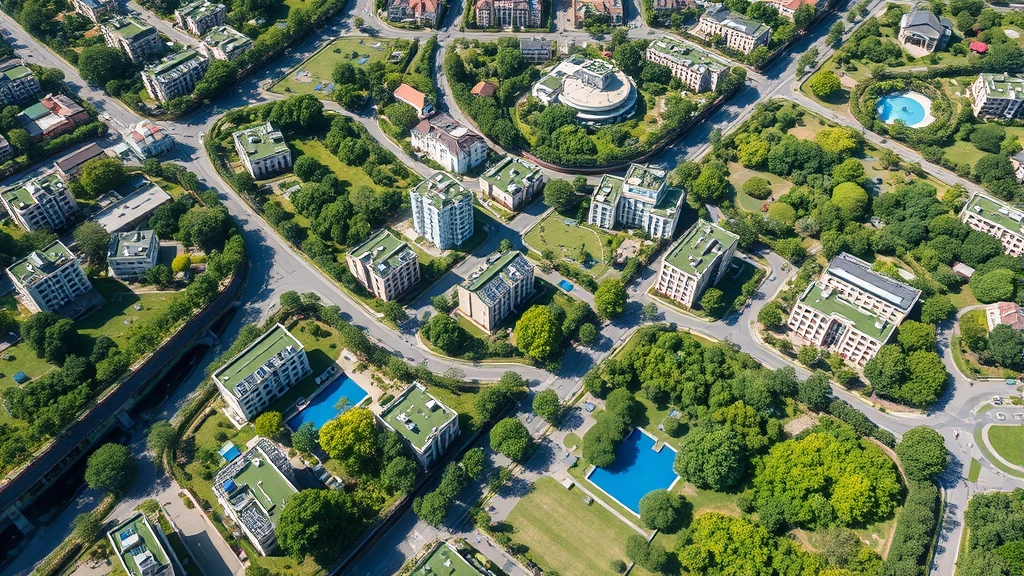
” alt=”Aerial view of sustainable city district with green roofs, solar panels, tree-lined streets, parks, and mixed-density buildings, blue water features”>
FAQ
What exactly is the built environment and why does it matter economically?
The built environment comprises all human-constructed infrastructure—buildings, roads, utilities, bridges, and public spaces—that shape how communities function. It matters economically because it represents the largest global asset class, influences productivity, determines real estate values, shapes transportation efficiency, and generates environmental externalities affecting long-term economic sustainability. Quality built environments attract investment and talent while enabling efficient commerce and innovation.
How does infrastructure investment directly impact economic growth?
Infrastructure investment reduces business transaction costs, expands market access, improves workforce health and productivity, and enables technological adoption. Research shows one percent infrastructure increases correlate with 0.08-0.15% GDP growth. Additionally, infrastructure construction directly employs millions while generating multiplier effects through supply chains and consumer spending. However, returns depend on quality planning and maintenance—poorly designed infrastructure generates negative returns.
What is the relationship between urban design and worker productivity?
Dense, mixed-use urban design facilitates knowledge spillovers and agglomeration economies while reducing commute times that represent substantial productivity losses. Quality office environments with natural light and ergonomic design improve worker performance by 5-15%. However, remote work emergence suggests physical proximity matters less for some knowledge workers, requiring diversified built environment configurations.
How do environmental externalities affect built environment economics?
The built environment generates substantial negative externalities—air pollution, climate emissions, water contamination, and habitat destruction—that impose costs on society without compensation to developers. When these external costs are properly valued, many development patterns prove economically irrational. Sustainable built environment design attempts to internalize these externalities, often improving long-term economic returns while reducing environmental damage.
Can sustainable development in built environments provide economic benefits?
Yes. Green buildings generate 10-30% operational savings through energy and water efficiency, offsetting 5-15% upfront cost premiums. Renewable energy now costs less than fossil fuels in most contexts. Urban green space increases property values by 5-20% while generating health benefits. However, policy support remains necessary to overcome transition costs and split incentives between different stakeholder groups.
How does the built environment contribute to regional economic inequality?
Quality built environment infrastructure attracts investment and talent, concentrating prosperity in developed regions. Poor regions lacking adequate infrastructure struggle economically despite potentially lower labor costs. Infrastructure alone proves insufficient for development—comprehensive built environment modernization integrated with education, governance, and market access improvements offers most promising pathways for reducing regional disparities.


