
Tech’s Environmental Impact: A Balanced Overview
Technology fundamentally reshapes our relationship with the natural world, creating a paradox that defines contemporary environmental economics. While digital innovation drives unprecedented efficiency gains and enables renewable energy transitions, the manufacturing, operation, and disposal of technological devices generate substantial ecological costs. Understanding this duality requires moving beyond simplistic narratives of progress or decline to examine how technological systems interact with planetary boundaries, resource extraction patterns, and economic incentive structures.
The environmental footprint of technology extends across multiple dimensions: rare earth mining in ecologically sensitive regions, energy consumption in data centers and manufacturing facilities, electronic waste accumulation in developing nations, and the resource intensity of semiconductor production. Simultaneously, technologies like precision agriculture, renewable energy systems, carbon capture mechanisms, and environmental monitoring platforms offer tangible pathways toward sustainability. This comprehensive analysis explores both dimensions, examining the systemic relationships between technological advancement and ecological outcomes through an interdisciplinary lens combining environmental economics, industrial ecology, and systems thinking.
The Dual Nature of Technology and Environmental Systems
Technology operates within complex socio-ecological systems where unintended consequences frequently emerge from well-intentioned innovations. The relationship between technological development and environmental outcomes cannot be reduced to simple causality. Instead, it reflects deeper structural patterns in how economies value natural capital, distribute externalities, and measure progress. Understanding human-environment interaction examples reveals how technological systems create feedback loops that either reinforce or mitigate ecological damage.
From an environmental economics perspective, technology embodies embodied energy—the cumulative energy required across its entire lifecycle from extraction through manufacturing, transportation, use, and disposal. A smartphone contains approximately 240 kilograms of raw materials extracted to produce just 100 grams of finished product. This 240:1 ratio illustrates the material intensity hidden within seemingly dematerialized digital devices. The economic system rarely prices these extraction costs, treating mineral resources as infinite commons rather than finite stocks with regeneration constraints.
The paradox intensifies when examining technological solutions to environmental problems. Renewable energy systems require extensive mineral inputs for batteries, solar panels, and wind turbines. Electric vehicles necessitate lithium, cobalt, and nickel extraction, often from regions with minimal environmental regulation. Digital platforms designed to optimize resource use simultaneously drive consumption increases through algorithmic recommendation systems and just-in-time delivery networks. This rebound effect—where efficiency improvements generate increased consumption—demonstrates how technological systems operate within economic structures that prioritize growth over ecological boundaries.
Understanding the broader context of how humans affect the environment requires examining technology not as neutral tools but as embedded within value systems, incentive structures, and power relationships. The choice to manufacture products with planned obsolescence, design non-repairable systems, or extract resources from ecologically critical regions reflects economic decisions, not technological inevitability.
Resource Extraction and Ecological Degradation
The technological supply chain depends fundamentally on resource extraction—mining operations that transform landscapes, contaminate water systems, and disrupt ecosystems. Rare earth element extraction, essential for renewable energy and electronics, generates significant environmental damage. Processing rare earths requires harsh chemical leaching that produces acidic and radioactive waste streams. The Baiyun Obo mine in China, source of approximately 70% of global rare earth production, has created massive tailings ponds containing toxic residues that percolate into groundwater systems affecting millions of people.
Cobalt mining in the Democratic Republic of Congo illustrates extraction economics divorced from environmental accountability. Artisanal cobalt mining operations lack environmental controls, generating acid mine drainage that contaminates agricultural land and drinking water sources. Child labor in cobalt mines represents another externality—social costs completely disconnected from market prices that consumers pay for batteries. The economic incentive structure rewards companies that externalize these costs onto vulnerable communities and ecological systems.
Copper extraction for electrical wiring and renewable energy infrastructure generates substantial waste. Producing one ton of copper requires processing approximately 250 tons of ore, creating massive tailings that can persist as environmental hazards for centuries. The 2015 Samarco dam failure in Brazil, where mining tailings contaminated 600 kilometers of river systems, demonstrates how cost-cutting in waste management creates catastrophic ecological consequences. Economic models that treat environmental damage as externalities rather than central costs enable such disasters.
Water consumption in technology manufacturing represents another critical impact. Semiconductor fabrication requires approximately 3,000 gallons of water per wafer, draining aquifers in water-stressed regions. Intel’s manufacturing facilities in Arizona consume water equivalent to a city of 250,000 people, in a region experiencing severe drought conditions exacerbated by climate change. This concentration of water-intensive manufacturing in arid regions demonstrates how technology production exacerbates existing environmental vulnerabilities rather than addressing them.

Energy Consumption and Carbon Emissions
The carbon footprint of technology extends far beyond device manufacturing into the operational phase. Data centers globally consume approximately 1% of worldwide electricity, a figure projected to increase substantially as artificial intelligence, cloud computing, and cryptocurrency operations expand. Large language models require enormous computational resources—training a single AI model can generate 300 metric tons of carbon dioxide equivalent emissions, equivalent to five times the lifetime emissions of an average American car.
Manufacturing a single laptop generates approximately 300 kilograms of carbon dioxide equivalent emissions during production, while a smartphone produces roughly 70 kilograms. These manufacturing emissions often exceed operational emissions over a device’s lifespan, yet replacement cycles continue accelerating. The average smartphone replacement cycle has shortened from 3-4 years to 2-3 years, driven by planned obsolescence, software updates that slow older devices, and marketing strategies emphasizing new features rather than durability.
The electricity grid’s carbon intensity determines whether technology deployment genuinely reduces emissions. In regions with renewable-dominated grids, electric vehicles and heat pumps provide substantial emissions reductions. In coal-dependent regions, these same technologies produce minimal climate benefits. Rather than fundamental technological change, decarbonization requires simultaneous transformation of energy infrastructure, manufacturing processes, and consumption patterns. Technology cannot solve climate change independent of systemic economic restructuring.
Cryptocurrency mining illustrates how technology can amplify environmental destruction. Bitcoin mining consumes approximately 150 terawatt-hours annually, equivalent to the electricity consumption of Argentina. The vast majority of this energy generates no productive economic output beyond speculative financial gains. From an environmental economics perspective, cryptocurrency represents pure resource waste—energy consumption divorced from meeting human needs or generating ecosystem services.
Electronic Waste: The Hidden Cost of Innovation
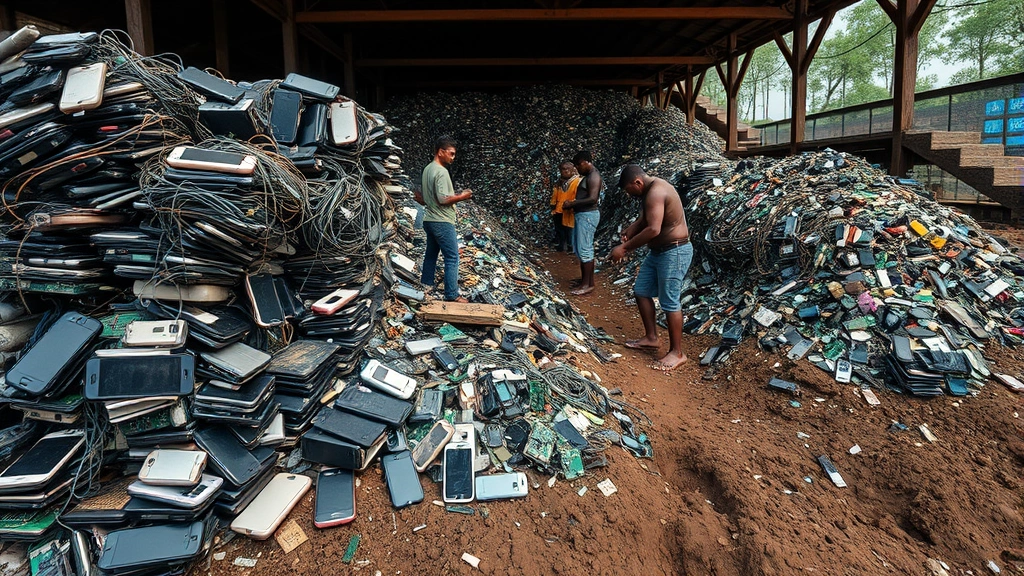
Approximately 60 million metric tons of electronic waste enters the global waste stream annually, with only 20% properly recycled. The remainder enters developing nations where informal recycling operations expose workers and communities to toxic substances including lead, mercury, cadmium, and flame retardants. The Agbogbloshie electronic waste dump in Ghana has become a symbol of technology’s dark side—mountains of discarded devices creating toxic landscapes where informal workers extract valuable materials while poisoning themselves and surrounding communities.
Electronic waste recycling economics illustrate how market failures perpetuate environmental damage. Properly recycling a smartphone costs approximately $15, while extracting valuable materials manually in developing nations costs $1. Economic incentives drive waste toward informal recycling rather than certified facilities, externalizing health and environmental costs onto vulnerable populations. This represents environmental injustice—wealthy nations consuming technology while exporting its consequences to poor communities.
The material composition of electronic devices creates additional challenges. Modern smartphones contain approximately 60 different elements, many in concentrations too low for economical extraction with current technology. Designing devices for disassembly and material recovery requires fundamental changes in manufacturing philosophy away from miniaturization and integration toward modularity and repairability. Such changes reduce manufacturer profits by extending device lifespans and increasing repair competition.
Understanding positive impacts on the environment by humans requires examining how technology design choices could prioritize sustainability. Right-to-repair legislation in the European Union and emerging markets represents a policy response to planned obsolescence, requiring manufacturers to provide spare parts and repair documentation for extended periods. Such regulations create economic incentives for durable, repairable design rather than disposable consumption.
Positive Environmental Technologies and Solutions
Despite significant negative impacts, technology enables environmental solutions previously impossible. Precision agriculture uses sensors, drones, and artificial intelligence to optimize water, fertilizer, and pesticide application, reducing agricultural chemical inputs by 20-40% while maintaining yields. This technology-enabled efficiency reduces environmental contamination while maintaining food security—a genuine example of technology addressing environmental problems.
Renewable energy technologies demonstrate technology’s potential when deployed within appropriate policy frameworks. Solar photovoltaic costs have declined 90% over the past decade, making solar electricity cheaper than coal in most markets. Wind energy generates electricity with lifecycle emissions approximately 50 times lower than natural gas. These technologies fundamentally depend on technological innovation—efficiency improvements in solar cell design, materials science advances in wind turbine manufacturing, and manufacturing scale-up that reduces costs.
Environmental monitoring technologies provide critical data for understanding ecological change. Satellite-based monitoring enables tracking of deforestation, ocean acidification, ice sheet loss, and atmospheric composition changes. These technologies create transparency around environmental degradation, supporting policy decisions and accountability mechanisms. Artificial intelligence applications in species identification, habitat modeling, and ecosystem monitoring accelerate conservation efforts.
Carbon capture technologies, though currently expensive and energy-intensive, represent a potential tool for addressing legacy emissions. Direct air capture technologies can extract carbon dioxide from ambient air, though current costs of $100-600 per ton remain uneconomical at scale. Developing technology to reduce capture costs represents a genuine innovation pathway, though carbon capture cannot substitute for emissions reductions.
The impact of technology on the environment depends fundamentally on implementation context. The same renewable energy infrastructure driving decarbonization in developed nations could enable resource extraction intensification in developing regions. Technology itself remains neutral; outcomes depend on policy frameworks, economic incentives, and distribution of decision-making power.
Economic Models for Sustainable Technology
Transitioning toward sustainable technology requires fundamental changes in economic models that price environmental externalities. Circular economy frameworks propose designing technology systems for material recovery rather than disposal. Instead of linear extraction-manufacturing-disposal cycles, circular models emphasize product-as-service arrangements where manufacturers retain material ownership, incentivizing durability and repairability.
Extended producer responsibility (EPR) policies create economic incentives for sustainable design by requiring manufacturers to manage end-of-life product disposal. When manufacturers internalize disposal costs, designing for disassembly and material recovery becomes economically rational. Several European countries have implemented EPR for electronics, generating market shifts toward repairability and reduced material intensity.
Natural capital accounting frameworks attempt to value ecosystem services and resource depletion within economic decision-making. Rather than treating rare earth extraction as pure profit, accounting frameworks would subtract resource depletion costs and ecosystem damage from financial returns. Implementing such accounting requires political will to challenge growth-oriented GDP metrics that ignore environmental costs.
Technological innovation requires investment in research and development, yet market mechanisms systematically under-invest in environmental solutions. The private benefits from manufacturing disposable devices exceed the social benefits from developing durable, repairable alternatives. Government investment in sustainable technology research, coupled with regulatory requirements for sustainable design, can overcome these market failures.
The definition of environment in science encompasses complex systems where technological interventions generate cascading effects across ecological, social, and economic dimensions. Economic models must incorporate this complexity rather than treating environment as an external variable.
Policy Frameworks and Market Mechanisms
Effective policy responses to technology’s environmental impact require combining regulatory requirements with economic incentives. Carbon pricing mechanisms—whether carbon taxes or cap-and-trade systems—internalize climate costs, making clean technology economically competitive. The European Union’s Emissions Trading System has driven renewable energy deployment by pricing carbon emissions at approximately €80-90 per ton, making fossil fuels uncompetitive.
Extended producer responsibility policies, already implemented for electronics in numerous countries, create accountability for end-of-life management. Manufacturers facing disposal costs invest in design improvements that reduce material intensity and enable recycling. Studies of EPR implementation show material recovery rates increasing from under 10% to 50-70% when manufacturers internalize disposal costs.
Right-to-repair legislation mandates that manufacturers provide spare parts and repair documentation, extending device lifespans and reducing electronic waste. France’s right-to-repair law requires manufacturers to provide spare parts for 10 years, fundamentally changing device design economics. This policy framework aligns manufacturer incentives with environmental objectives.
International agreements addressing technology’s environmental impacts remain limited. The Basel Convention restricts hazardous waste export but lacks enforcement mechanisms. The Minamata Convention addresses mercury in electronics but covers only a fraction of toxic substances. Stronger international frameworks requiring sustainable technology standards and preventing waste dumping in developing nations represent critical policy gaps.
Tax incentives for sustainable technology adoption accelerate market transitions. Subsidies for renewable energy deployment, electric vehicles, and energy-efficient devices reduce upfront costs, enabling consumer adoption. However, such incentives require careful design to avoid perverse outcomes—subsidizing electric vehicle production in regions with coal-based electricity grids generates minimal emissions reductions.
Research and development investment in sustainable technology remains critical. Government-funded research drives technological breakthroughs that private markets cannot support due to high risk and extended payback periods. The U.S. Department of Energy’s funding of battery research, solar cell development, and carbon capture technologies demonstrates how public investment enables technological transitions.
According to World Bank environmental research, integrating environmental costs into technology policy represents essential infrastructure for sustainable development. Developing nations face particular challenges as they pursue technological advancement without the environmental protection infrastructure established in wealthy countries.
United Nations Environment Programme initiatives address technology’s environmental impacts through capacity building, technology transfer, and policy support. UNEP’s circular economy initiatives promote sustainable technology design across developing regions, though implementation remains limited by financing constraints.
Research from Resources for the Future demonstrates that technology’s environmental outcomes depend critically on policy context. The same technologies generate vastly different environmental results depending on whether policies encourage efficiency or consumption, durability or disposability, recycling or disposal.
Ecological economics journals publish research examining technology’s role within planetary boundaries. This interdisciplinary field emphasizes that technology cannot overcome biophysical limits—infinite growth remains impossible on a finite planet regardless of technological efficiency gains.
The Ecorise Daily Blog provides ongoing analysis of technology-environment interactions, exploring emerging technologies and their ecological implications. Staying informed about these complex relationships enables more sophisticated environmental policy advocacy.
FAQ
What is the biggest environmental impact of technology?
Resource extraction for manufacturing represents the most significant impact, followed by operational energy consumption and electronic waste generation. The mining of rare earth elements, precious metals, and minerals for device manufacturing generates ecosystem degradation, water contamination, and significant carbon emissions that often exceed operational phase impacts.
Can technology solve environmental problems?
Technology provides necessary tools for environmental solutions but cannot independently overcome systemic challenges. Renewable energy, precision agriculture, and environmental monitoring technologies offer genuine benefits, yet they remain embedded within economic systems that prioritize consumption and growth. Technological solutions require simultaneous changes in policy, economic incentives, and consumption patterns.
Is electronic waste recyclable?
Electronic waste contains valuable materials including copper, gold, and rare earth elements that are technically recyclable. However, only approximately 20% of electronic waste enters formal recycling systems due to economic incentives favoring informal recycling in developing nations. Designing devices for easier disassembly and material recovery could improve recycling rates significantly.
How can technology become more sustainable?
Sustainable technology requires design changes prioritizing durability and repairability over disposability, policy frameworks creating economic incentives for sustainable design, extended producer responsibility policies, right-to-repair legislation, and circular economy business models. Additionally, reducing overall consumption of technology—particularly planned obsolescence—represents the most direct environmental improvement.
Does renewable energy technology truly reduce emissions?
Renewable energy technologies reduce operational emissions dramatically compared to fossil fuels, but manufacturing impacts remain significant. Lifecycle assessment shows renewable energy systems generate 50-90% lower lifetime emissions than fossil fuel electricity. The environmental benefit depends on grid electricity mix during manufacturing and the energy source powering production facilities.
What role should government play in technology’s environmental impacts?
Governments must establish regulatory frameworks requiring sustainable design, implement economic incentives for clean technology adoption, invest in research enabling technological breakthroughs, enforce accountability for environmental damage, and prevent wealthy nations from exporting technology’s environmental costs to developing countries through proper waste management standards.


