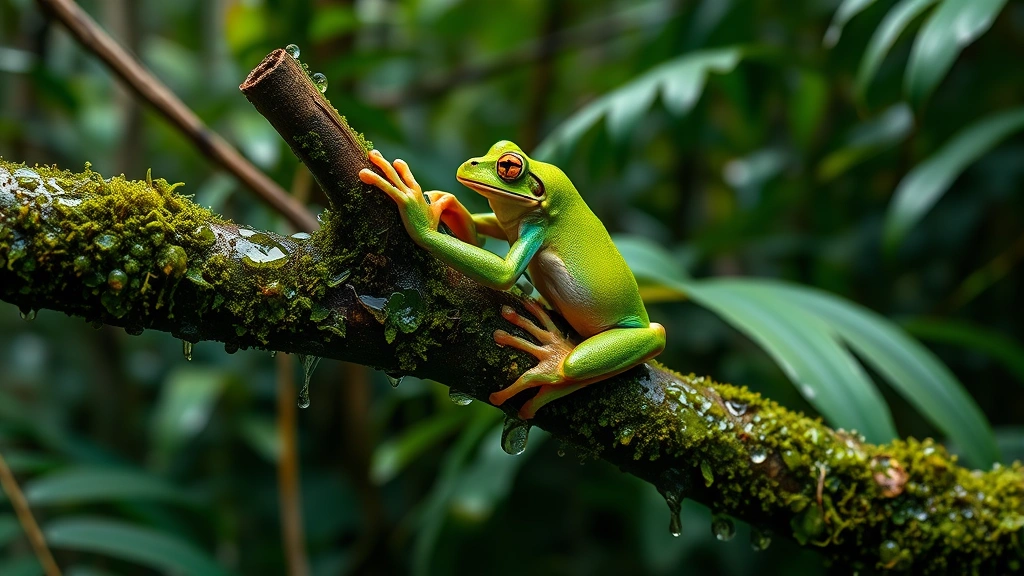
Tree Frogs’ Role in Ecosystems: A Biologist’s Insight into Environmental Balance
Tree frogs represent one of nature’s most fascinating and economically significant amphibian groups, occupying critical niches across tropical, subtropical, and temperate forest ecosystems worldwide. These arboreal specialists have evolved remarkable adaptations that extend far beyond their aesthetic appeal, functioning as essential indicators of ecosystem health and players in complex ecological networks that support biodiversity and maintain environmental stability. Understanding their ecological roles provides invaluable insights into broader principles of environmental science and the interconnected nature of biological systems.
From an ecological economics perspective, tree frogs deliver substantial ecosystem services that translate into measurable environmental and economic value. Their presence indicates water quality, forest integrity, and the overall health of woodland habitats—metrics that conservation economists increasingly recognize as foundational to sustainable development. This comprehensive analysis explores the multifaceted roles tree frogs play in maintaining ecosystem functionality while examining the economic implications of their conservation and the consequences of their decline.
Ecological Functions and Biodiversity Support
Tree frogs occupy specialized ecological niches that make them indispensable components of forest ecosystems. These amphibians inhabit the arboreal layers of forests—from understory vegetation to the canopy heights—where they interact with hundreds of other species in complex webs of predation, competition, and mutualism. Their vertical distribution across forest strata means they access resources unavailable to ground-dwelling species, effectively utilizing energy and nutrients that might otherwise remain locked in upper forest layers.
The biodiversity supported by tree frog populations extends across multiple trophic levels. Larval stages in water bodies support aquatic invertebrate communities, while adult frogs in trees interact with aerial insects, spiders, and other arthropods. This vertical integration of tree frogs into forest ecosystems creates connectivity between aquatic and terrestrial environments, facilitating nutrient transfer and energy flow that strengthens overall ecosystem resilience. Research indicates that areas with healthy tree frog populations demonstrate significantly higher arthropod diversity and more stable insect communities—factors directly linked to pollination services and pest control functions.
Tree frog species often exhibit remarkable ecological specialization. Some species breed exclusively in bromeliads or tree holes, creating microhabitats that support entirely distinct invertebrate assemblages. Others migrate seasonally between forest layers, and their movement patterns influence the distribution of nutrients and genetic material across forest compartments. The ecosystem services these migrations facilitate remain largely quantified only through ecosystem modeling, yet their importance to forest function cannot be overstated.
Predator-Prey Dynamics and Food Web Architecture
Understanding tree frog roles requires examining their position within food webs as both predators and prey. As predators, tree frogs consume vast quantities of arthropods—insects, spiders, and other invertebrates that might otherwise reach pest densities. A single tree frog can consume hundreds of insects annually, and in forests with substantial frog populations, this predation pressure represents a significant ecological force shaping arthropod community composition.
The economic implications of this predation function become apparent when considering agricultural systems adjacent to forests. Insectivorous tree frog populations in riparian zones and forest edges provide natural pest control services that reduce crop damage and decrease reliance on synthetic pesticides. Studies from Central American cacao plantations adjacent to intact forests demonstrate that areas maintaining tree frog populations experience 15-25% reductions in pest-related crop losses compared to isolated agricultural zones.
Conversely, tree frogs occupy crucial positions as prey for snakes, birds, and mammals. Their reproductive output—producing thousands of eggs annually in many species—supports predator populations that might otherwise face food limitations. This prey function is particularly critical during breeding seasons when concentrated egg masses and tadpole aggregations provide concentrated food sources. The loss of tree frog populations cascades through predator communities, disrupting population dynamics of snakes, specialized birds, and mammals that depend on amphibian prey.
The architectural complexity of food webs involving tree frogs creates redundancy and stability in forest ecosystems. When multiple tree frog species occupy similar niches, the loss of one species may not collapse the entire system, but when entire guilds of tree frogs disappear, food web gaps emerge that destabilize remaining communities. This principle of functional redundancy has become central to conservation planning, influencing how ecologists assess ecosystem vulnerability to species loss.

Nutrient Cycling and Forest Productivity
Tree frogs participate in nutrient cycling processes that enhance forest productivity and maintain soil fertility. As amphibians with permeable skin, tree frogs absorb nutrients from their environment while simultaneously excreting metabolic wastes that enrich surrounding habitats. This nutrient exchange, while individually small per frog, becomes significant when considering populations numbering in the millions across forest regions.
The tadpole stage represents a particularly important nutrient cycling phase. Aquatic larvae accumulate nutrients from water bodies, incorporating them into biomass that subsequently moves into terrestrial ecosystems when tadpoles metamorphose into terrestrial or semi-arboreal adults. This lateral movement of nutrients from aquatic to terrestrial systems represents a significant ecological subsidy, particularly in nutrient-poor tropical forests where such transfers substantially boost primary productivity.
Research examining isotope signatures in forest vegetation demonstrates that nutrient pathways involving amphibians contribute measurably to plant nutrition. Frogs that consume arthropods containing marine-derived nutrients or nutrients from other forest compartments effectively redistribute these resources, preventing localized depletion and maintaining balanced nutrient availability across forest layers. This cycling function becomes increasingly important in forests recovering from disturbance, where human impacts on forest nutrient cycles have disrupted natural regeneration processes.
The connection between tree frog populations and forest productivity has economic significance for timber management and carbon sequestration. Forests maintaining healthy amphibian communities demonstrate faster growth rates and higher carbon accumulation compared to forests with depleted amphibian faunas. This relationship, while not yet fully incorporated into forest carbon accounting, suggests that amphibian conservation delivers co-benefits for climate change mitigation through enhanced forest productivity.
Tree Frogs as Bioindicators of Environmental Health
Tree frogs function as sensitive bioindicators of environmental quality, responding rapidly to habitat degradation, water pollution, and climate change. Their permeable skin, complex life cycles involving both aquatic and terrestrial phases, and sensitivity to microhabitat conditions make them excellent monitors of ecosystem integrity. Conservation biologists increasingly employ tree frog surveys as cost-effective methods for assessing forest health and detecting environmental problems before they become catastrophic.
The presence or absence of specific tree frog species indicates particular environmental conditions. Some species tolerate only pristine, undisturbed forests with intact canopy cover and abundant moisture. Others adapt to secondary growth and disturbed habitats. This variation creates a gradient of indicator species that ecologists use to classify forest condition and trajectory. Human-environment interactions become measurable through shifts in tree frog communities, with species composition changes often preceding visible habitat degradation.
Water quality assessment through amphibian monitoring has proven particularly valuable in agricultural and industrial regions. Tree frogs breeding in wetlands adjacent to farms or factories show developmental abnormalities, population declines, and behavioral changes when exposed to pesticides, heavy metals, or nutrient pollution. These responses provide early warning signals that allow environmental managers to implement corrective measures before water resources become unsuitable for human use.
Climate change impacts manifest clearly through tree frog populations. Shifts in breeding phenology, range expansions and contractions, and changes in community composition reflect temperature and precipitation changes before broader ecosystem transformations become apparent. Long-term monitoring programs tracking tree frog populations provide invaluable data for understanding climate change impacts on tropical and subtropical ecosystems, informing adaptation strategies for conservation and resource management.
Economic Value and Ecosystem Services
The economic valuation of tree frog ecosystem services represents a developing field in ecological economics, with studies employing various methodologies to quantify the monetary value of their ecological contributions. The World Bank has increasingly incorporated amphibian conservation into ecosystem service valuations, recognizing that the loss of amphibian populations represents a measurable decline in natural capital and ecosystem service provision.
Pest control services provided by tree frog populations in tropical regions have been valued at hundreds of millions of dollars annually when extrapolated across global forest areas. These services reduce agricultural losses, decrease pesticide application costs, and diminish environmental contamination from synthetic chemicals. In regions like Central America and Southeast Asia, maintaining forested corridors specifically to preserve tree frog populations has become an economically rational conservation strategy that delivers agricultural benefits alongside biodiversity protection.
Ecotourism represents another significant economic dimension of tree frog conservation. Tropical forests with intact amphibian communities attract researchers and tourists willing to pay substantial fees for guided nature experiences and accommodation. In Costa Rica, Ecuador, and Madagascar, tree frog viewing has become a major ecotourism draw, generating local income that incentivizes forest protection. Economic studies demonstrate that the ecotourism value of living tree frogs far exceeds the extractive value of forest conversion to agriculture or other land uses in many regions.
Pharmaceutical and scientific value of tree frogs adds further economic dimensions to their conservation. Compounds derived from tree frog skin secretions have yielded promising pharmaceutical leads for pain management, antimicrobial applications, and other medical treatments. The potential future value of undiscovered compounds in unstudied tree frog species creates an option value that economists include in comprehensive cost-benefit analyses of forest conservation.
The ecosystem service of water purification and hydrological regulation provided by forests maintaining healthy tree frog populations also carries measurable economic value. Forests support water cycling that replenishes aquifers and maintains streamflow, services valued through avoided water treatment costs and maintained agricultural productivity. Tree frog populations indicate forest conditions that optimize these hydrological services, making amphibian monitoring a cost-effective proxy for assessing water resource sustainability.
Threats and Conservation Economics
Tree frog populations face unprecedented threats from habitat loss, climate change, infectious disease, and pollution—challenges that demand sophisticated conservation economics approaches. Habitat fragmentation represents the primary threat across most regions, as forest conversion to agriculture, urban development, and resource extraction eliminates both breeding habitats and terrestrial refugia that tree frogs require. The economic drivers of habitat loss—agricultural expansion, timber harvesting, and infrastructure development—create conflicts between short-term economic gains and long-term ecosystem service provision.
Chytrid fungal disease, which devastates amphibian populations globally, illustrates how biological threats interact with economic systems. The disease spreads through trade in amphibians for the pet industry and through natural dispersal pathways, with prevention requiring coordination across international borders and across public and private sectors. The economic costs of disease management through habitat protection and breeding programs, while substantial, remain far less than the value of ecosystem services lost when tree frog populations collapse.
Conservation strategies increasingly employ payment for ecosystem services (PES) mechanisms and market-based conservation approaches that align economic incentives with biodiversity protection. In tropical regions, programs compensating landowners for maintaining forest cover that supports tree frog populations have demonstrated effectiveness in slowing deforestation while generating local income. These approaches recognize that sustainable conservation requires making biodiversity protection economically competitive with extractive land uses.
Climate change presents novel conservation challenges as tree frog ranges shift and breeding phenology becomes misaligned with resource availability. UNEP climate change initiatives increasingly incorporate amphibian conservation into adaptation planning, recognizing that protecting tree frog populations requires maintaining habitat connectivity that facilitates range shifts and preserving elevational gradients that provide climate refugia.
The economic case for tree frog conservation strengthens considerably when comprehensive ecosystem service valuations incorporate multiple benefit streams—pest control, water purification, pharmaceutical potential, carbon sequestration, and ecotourism. Studies employing integrated valuation approaches demonstrate that forest protection supporting tree frog populations generates net economic benefits exceeding conversion to alternative land uses across most tropical regions. This economic reality, combined with ethical and scientific arguments for biodiversity conservation, creates a compelling case for prioritizing tree frog habitat protection in land use planning and policy decisions.
Ecological economics research continues refining methodologies for valuing amphibian ecosystem services, with emerging consensus that underestimating these values has driven excessive habitat conversion and species loss. Incorporating amphibian conservation into strategies for reducing environmental footprints requires recognizing tree frogs as essential components of functional, productive ecosystems that support human wellbeing through multiple pathways.
FAQ
What specific ecosystem services do tree frogs provide?
Tree frogs provide pest control through insect predation, contribute to nutrient cycling between aquatic and terrestrial systems, serve as bioindicators of water and habitat quality, support food webs as both predators and prey, and facilitate pharmaceutical research through unique biochemical compounds. Their presence indicates forest productivity and hydrological function, making them valuable for ecosystem assessment and management.
How do tree frog population declines affect forests?
Declines in tree frog populations reduce pest control services, disrupting arthropod communities and potentially increasing crop pest pressure. Loss of nutrient cycling contributions slows forest productivity and carbon accumulation. Food web gaps emerge as predators lose prey sources. Most critically, amphibian declines indicate broader ecosystem degradation, signaling problems with water quality, habitat integrity, and climate stability that affect all forest-dependent species.
Can tree frog conservation generate economic returns?
Yes, substantial economic returns emerge through multiple pathways: pest control services reduce agricultural costs, ecotourism generates local income, pharmaceutical research yields valuable compounds, and forest protection supporting tree frogs provides carbon sequestration benefits. Payment for ecosystem services programs demonstrate that compensating landowners for maintaining tree frog habitat proves economically efficient compared to costs of ecosystem service loss.
How do tree frogs indicate climate change impacts?
Tree frogs respond to temperature and precipitation changes through shifts in breeding timing, range movements to higher elevations or latitudes, changes in community composition, and population size fluctuations. These responses often precede visible climate impacts on other species, making amphibian monitoring valuable for detecting and adapting to climate change effects on forest ecosystems.
What role do tree frogs play in water systems?
Tree frogs breeding in water bodies influence aquatic invertebrate communities and nutrient cycling in freshwater systems. Their tadpole stage accumulates nutrients and biomass in water, which transfers to terrestrial ecosystems upon metamorphosis. Adult frogs influence riparian vegetation and hydrological processes through their presence and activities, contributing to water quality maintenance and watershed function.


