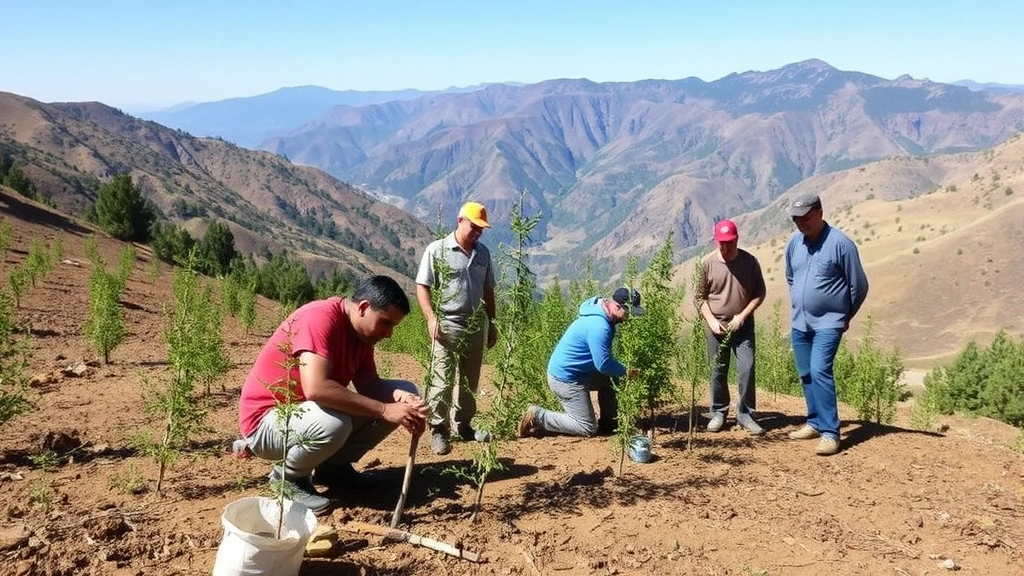
Can Afforestation Boost Local Economy? Study Insights
Afforestation—the deliberate establishment of forests in areas where trees have been absent for decades or centuries—represents one of the most compelling intersections of environmental restoration and economic development. Recent research demonstrates that strategic tree-planting initiatives generate substantial economic returns while simultaneously addressing climate change, biodiversity loss, and ecosystem degradation. This comprehensive analysis explores how afforestation projects create measurable economic benefits for local communities, supported by empirical data and case studies from global initiatives.
The economic potential of afforestation extends far beyond carbon credit markets. When designed with local stakeholder engagement and long-term management strategies, these projects generate employment, enhance agricultural productivity, stabilize local climates, and create new revenue streams through timber, non-timber forest products, and ecosystem services. Understanding these mechanisms is essential for policymakers, investors, and communities seeking sustainable economic pathways.

Economic Mechanisms of Afforestation
Afforestation creates economic value through multiple interconnected channels. The primary mechanism involves transforming previously unproductive or degraded land into asset-generating ecosystems. According to research from the World Bank’s forest economics division, planted forests contribute approximately $296 billion annually to global GDP, representing 2% of total forest-related economic activity.
The economic model functions through several pathways. First, afforestation establishes biomass that can be harvested for timber, fuelwood, and pulp—products with established market demand. Second, the trees provide ecosystem services that enhance human-environment interaction, including water filtration, erosion control, and microclimate regulation. Third, these projects generate income through carbon markets, where verified emission reductions command premium prices. Fourth, afforestation attracts investment capital, technology transfer, and technical expertise to participating regions.
The World Bank estimates that every hectare of planted forest generates $1,200 to $2,500 in ecosystem service value over a 20-year rotation cycle. This valuation encompasses carbon sequestration, watershed protection, biodiversity habitat creation, and recreational amenities. For developing economies with limited industrial infrastructure, these services represent substantial wealth creation that doesn’t require heavy capital investment in manufacturing.

Employment Creation and Labor Markets
Employment generation represents afforestation’s most immediate economic impact for rural communities. The International Labour Organization documents that forest-related activities employ over 13.8 million people globally, with afforestation and reforestation accounting for approximately 1.2 million direct jobs. These employment opportunities span multiple skill levels and seasonal patterns.
The employment trajectory follows distinct phases. During establishment (years 1-3), labor demand peaks for site preparation, seedling production, planting, and initial maintenance. A single hectare of afforestation typically requires 15-25 person-days of labor during establishment. This translates to substantial income for unskilled workers in regions with limited employment alternatives. For a typical 1,000-hectare afforestation project in sub-Saharan Africa or South Asia, establishment phase employment reaches 15,000-25,000 person-days, generating $150,000-$300,000 in wage income.
The intermediate phase (years 4-15) requires less intensive labor but creates specialized employment in tending, pruning, pest management, and fire prevention. This phase sustains 2-4 person-days per hectare annually, creating stable, predictable income for trained technicians. The harvest phase (years 15-25+) generates employment in felling, processing, and transportation, creating opportunities for skilled workers and entrepreneurs. A 1,000-hectare plantation reaching harvest maturity can generate 5,000-8,000 person-days of employment during harvest operations alone.
Beyond direct employment, afforestation stimulates indirect job creation in nurseries, equipment supply, transportation, and processing industries. Studies from the United Nations Environment Programme indicate that every direct forest job generates 0.6-1.2 indirect jobs in supporting sectors. In regions with high unemployment and limited economic diversification, this multiplier effect provides crucial economic stimulus.
Agricultural Productivity and Soil Enhancement
Afforestation significantly enhances agricultural productivity in adjacent areas through multiple mechanisms. Planted forests modify local hydrology, increasing groundwater recharge and reducing water stress during dry seasons. Research demonstrates that afforested watersheds increase water availability by 15-30% compared to non-forested baselines, directly benefiting downstream agricultural communities.
The relationship between trees and soil productivity operates through several pathways. Forest canopies reduce wind speed and evaporation stress, creating microclimates that favor crop growth. Leaf litter and organic matter decomposition enhance soil structure and nutrient cycling. Planted forests, particularly nitrogen-fixing species like acacias and legumes, naturally fertilize surrounding soils, reducing synthetic fertilizer dependency. Studies measuring biotic environment examples in agroforestry systems show that crop yields increase 20-40% when integrated with strategically placed tree plantations.
The economic benefit extends through reduced input costs. Farmers in afforested regions report 25-35% reductions in fertilizer expenditures and 15-25% reductions in irrigation water consumption. For smallholder farmers in water-scarce regions, these savings represent the difference between profitability and subsistence farming. The World Bank documents that agroforestry systems combining afforestation with crop production generate 1.5-2.5 times higher income per hectare compared to monoculture cropping alone.
Soil carbon accumulation provides additional economic benefits through carbon credit markets. Afforested soils sequester 0.5-1.5 tonnes of carbon per hectare annually, with cumulative sequestration reaching 20-40 tonnes per hectare over 20 years. This carbon storage creates monetizable assets through voluntary carbon markets and emerging compliance carbon schemes.
Carbon Finance and Payment for Ecosystem Services
Carbon finance mechanisms have emerged as the most significant revenue source for large-scale afforestation projects. The voluntary carbon market valued at $2 billion in 2021 allocates substantial capital to verified afforestation projects. Verified carbon credits from afforestation fetch $8-25 per tonne of CO2 equivalent, with premium credits reaching $50+ for projects meeting rigorous environmental and social standards.
A typical 1,000-hectare afforestation project generating 25 tonnes of CO2 sequestration annually produces 25,000 tonnes annually, translating to $200,000-$625,000 in annual carbon revenue at mid-range pricing. Over a 20-year project cycle, cumulative carbon revenue reaches $4-12.5 million, providing substantial capital for community development, project management, and reinvestment.
Beyond carbon finance, environmental considerations in technology deployment increasingly drive corporate investment in nature-based solutions. Companies seeking to offset unavoidable emissions invest directly in afforestation projects, creating long-term revenue stability. The UNEP Emissions Gap Report highlights that reaching net-zero targets requires scaling nature-based solutions like afforestation by 300-400%, creating unprecedented investment opportunities.
Payment for ecosystem services (PES) mechanisms complement carbon finance. Downstream water users pay upstream communities for watershed protection services provided by planted forests. Hydroelectric facilities, municipal water systems, and agricultural regions benefit from improved water quality and quantity. PES schemes typically generate $50-300 per hectare annually, providing stable, long-term income independent of commodity markets.
Biodiversity conservation finance represents another revenue stream. Conservation organizations and impact investors fund afforestation projects meeting biodiversity criteria, recognizing that planted forests provide crucial habitat for endangered species. These payments average $100-400 per hectare over project lifespans, creating financial incentives aligned with ecosystem restoration goals.
Global Case Studies and Evidence
Ethiopia’s Productive Safety Net Program demonstrates afforestation’s employment and income potential in low-income contexts. This initiative planted over 5 billion trees while employing 8 million workers over fifteen years, generating $500 million in direct wages. Participating communities experienced 30% reductions in poverty incidence and 25% improvements in food security. The program illustrates how afforestation simultaneously addresses unemployment, environmental degradation, and food insecurity.
China’s Grain-for-Green Program converted 32 million hectares of marginal cropland to forests, employing 1.2 million workers and generating $45 billion in ecosystem service value. Soil erosion declined 45%, agricultural productivity in protected watersheds increased 20%, and local incomes rose 35% as communities transitioned from subsistence farming to forest management and payment schemes. This large-scale project demonstrates that afforestation can economically benefit entire regions while restoring degraded ecosystems.
Costa Rica’s Payment for Ecosystem Services Program illustrates market-based mechanisms. Established in 1997, the program has enrolled 1.2 million hectares in conservation contracts, generating $600 million in payments. Participating landowners receive $50-100 per hectare annually for forest protection and restoration. The program created 25,000 forest-related jobs while increasing forest coverage from 24% to 52% of national territory. Property values in participating regions increased 15-20%, demonstrating that ecosystem conservation enhances rather than diminishes economic value.
India’s National Mission for Green India targets afforestation of 10 million hectares, projected to create 400,000 permanent jobs and 2 million seasonal positions. Initial phases demonstrate income increases of 40-60% for participating communities through timber sales, non-timber forest products, and ecosystem service payments. The program simultaneously helps reduce carbon footprint while supporting rural livelihoods.
Mozambique’s Sofala Province Afforestation Initiative engaged 50,000 smallholders in tree-planting, generating $15 million in carbon finance over eight years. Participating farmers increased household incomes 35%, reduced fuelwood collection time by 25 hours weekly, and improved soil fertility. The project demonstrates that afforestation benefits extend beyond direct employment to encompass time savings, resource availability, and productivity improvements.
Challenges and Implementation Barriers
Despite significant potential, afforestation faces substantial implementation challenges. Land tenure insecurity represents the most critical barrier. Without clear, legally recognized property rights, farmers lack incentive to invest in long-term tree cultivation. Approximately 40% of afforestation projects in developing regions experience tenure-related conflicts, reducing project viability and economic returns.
Upfront capital requirements create financing barriers. Establishment costs average $500-2,000 per hectare, representing substantial investment for poor communities. While carbon finance and ecosystem service payments provide long-term returns, the 5-10 year lag before substantial revenue generation creates cash flow challenges. Communities requiring immediate income often abandon projects before reaching profitability.
Species selection and climate adaptation present technical challenges. Inappropriate species selections result in poor growth, disease susceptibility, and project failure. Climate variability and changing precipitation patterns complicate species matching. Failed plantations generate negative economic returns, eroding community trust in afforestation initiatives.
Maintenance requirements demand sustained commitment. Weeding, tending, and protection from pests require 10-20 person-days per hectare annually during establishment. Inadequate maintenance reduces survival rates from target levels of 80%+ to actual outcomes of 40-50%, undermining economic viability. Resource-constrained communities struggle to maintain plantations while addressing immediate livelihood needs.
Market access limitations constrain revenue realization. Isolated communities lack infrastructure, transportation, and market information necessary to commercialize timber and non-timber forest products. Without processing facilities and market linkages, raw forest products command low prices, reducing income potential by 50-70% compared to processed alternatives.
Carbon market volatility creates financial uncertainty. Carbon credit prices fluctuate based on policy changes, market sentiment, and competing supply. Projects dependent on carbon finance face revenue unpredictability, complicating long-term planning and community investment decisions.
Policy Frameworks Supporting Afforestation
Effective policy frameworks address implementation barriers while creating enabling environments for afforestation investment. Land tenure formalization represents the foundational requirement. Governments must establish clear, legally recognized property rights and usage agreements, reducing tenure insecurity and enabling long-term investment decisions. Countries implementing comprehensive land certification programs experience 30-40% higher afforestation success rates.
Carbon pricing mechanisms—whether compliance carbon markets or carbon taxes—create financial incentives for afforestation. The EU Emissions Trading System, California’s cap-and-trade program, and emerging carbon pricing in developing nations drive investment in nature-based solutions. World Bank carbon pricing data shows that regions implementing carbon pricing experience 25-35% acceleration in afforestation adoption.
Subsidy structures supporting initial establishment costs lower barriers to participation. Direct grants covering 50-75% of establishment costs enable smallholders to engage while retaining long-term ownership benefits. Results-based payments—compensating only successful plantation survival—align incentives and reduce malinvestment.
Institutional strengthening in community forestry organizations enhances project sustainability. Training in forest management, financial accounting, market engagement, and conflict resolution builds local capacity for autonomous project management. Communities with strong institutions achieve 60% higher long-term success rates compared to externally managed initiatives.
Infrastructure investment in processing facilities, market linkages, and transportation networks multiplies economic returns. Communities with access to value-addition facilities generate 200-300% higher revenues from forest products. Public investment in rural infrastructure enables afforestation projects to achieve commercial viability.
Integration with renewable energy systems creates synergistic benefits. Biomass from afforestation provides sustainable energy feedstock, reducing fossil fuel dependence while creating additional revenue streams. Communities producing forest biomass for energy markets access premium prices while supporting climate-compatible energy transitions.
Regulatory frameworks protecting ecosystem services—through water quality standards, biodiversity protections, and climate commitments—create stable demand for afforestation outcomes. When regulations mandate ecosystem restoration or carbon neutrality, afforestation projects access reliable, long-term revenue sources.
The FAO’s Global Forest Resources Assessment demonstrates that countries implementing comprehensive afforestation policies achieve forest coverage expansion of 0.5-2% annually, compared to 0.1% in countries without coordinated policies. Policy coherence—aligning climate, agricultural, conservation, and economic policies—multiplies afforestation effectiveness and economic returns.
International financing mechanisms, including Green Climate Fund resources and bilateral development assistance, provide catalytic capital for afforestation projects. These mechanisms reduce project initiation costs and de-risk investments for communities and private investors, enabling faster scaling of successful models.
The integration of sustainable practices across economic sectors creates complementary demand for afforestation outcomes. Fashion brands, technology companies, and consumer goods manufacturers increasingly source forest products from certified sustainable sources, creating premium market opportunities for afforestation projects meeting environmental and social standards.
FAQ
How long before afforestation generates economic returns?
Economic returns emerge on different timescales. Employment generation occurs immediately during establishment (years 1-3). Non-timber forest products typically yield returns within 3-5 years. Carbon finance payments begin once projects achieve verification (typically 2-4 years). Timber harvesting—the largest revenue source—occurs at 15-25 years depending on species and management intensity. Diversified projects combining multiple revenue streams achieve positive cashflow within 5-8 years.
Can smallholder farmers participate in afforestation profitably?
Yes, when projects address tenure security, provide technical support, and combine multiple income streams. Smallholder participation increases when upfront costs are subsidized and farmers retain long-term ownership. Community-managed projects averaging 0.5-2 hectares per household generate $200-600 annually per hectare through combined timber sales, ecosystem service payments, and non-timber products—substantial income for rural households.
What species selection maximizes economic returns?
Economic optimization requires matching species to local conditions, market demand, and management capacity. Fast-growing species like eucalyptus and pine generate timber revenue quickly but require intensive management. Slower-growing native species provide ecosystem services and carbon sequestration with lower management requirements. Mixed-species plantations balance economic returns with ecosystem benefits and reduce risk through product diversification.
How do carbon credits work in afforestation projects?
Projects measure and verify carbon sequestration against baseline scenarios. Verified carbon credits—representing one tonne of CO2 equivalent removed—are issued and sold in voluntary or compliance carbon markets. Buyers include corporations offsetting emissions and governments meeting climate commitments. Credits provide long-term revenue independent of timber markets, stabilizing project economics.
What happens to afforestation projects after initial investment?
Successful projects transition to self-sustaining management. Communities trained in forest management continue operations with revenues from timber, non-timber products, and ecosystem service payments financing maintenance. Many projects establish perpetual management funds ensuring long-term stewardship. Government support through subsidies and market linkages enables sustained economic viability.


