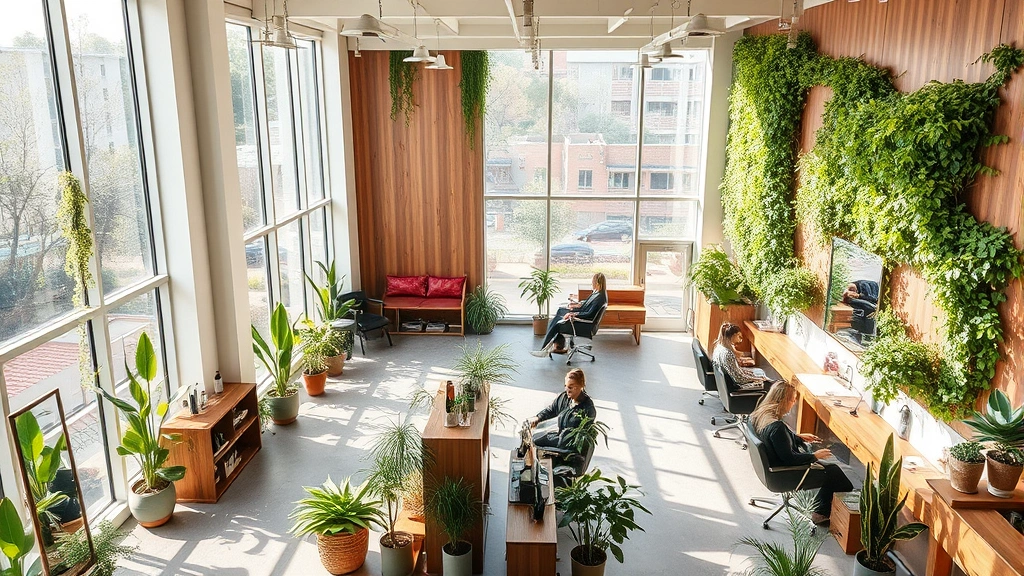
Can Green Salons Boost Local Economies? Study Insights
The salon industry, traditionally dominated by water-intensive operations and chemical-heavy practices, stands at a critical juncture. As environmental consciousness permeates consumer behavior, green salons—establishments adopting sustainable practices—are emerging as potential catalysts for local economic growth. Recent research suggests that the salon environment transformation toward sustainability creates measurable economic benefits while addressing ecological imperatives. This intersection of environmental stewardship and economic vitality challenges conventional business models and opens pathways for community-centered growth.
Green salons represent more than aesthetic or ethical choices; they embody a systemic shift in how service industries can operate profitably while reducing environmental degradation. By examining empirical data, economic mechanisms, and real-world case studies, we can understand whether green salons genuinely boost local economies or remain niche markets with limited broader impact. The evidence suggests a nuanced picture: when properly implemented within supportive policy frameworks, green salons generate direct employment, attract investment, and stimulate secondary economic activity—while simultaneously reducing the environmental costs typically externalized by conventional operations.

Understanding Green Salons and Their Economic Model
Green salons operate within a fundamentally different economic paradigm than conventional beauty establishments. A green salon typically incorporates water conservation systems, non-toxic chemical products, energy-efficient equipment, waste reduction protocols, and sustainable sourcing practices. Rather than viewing these measures as cost burdens, forward-thinking operators integrate them into value propositions that attract environmentally conscious consumers willing to pay premium prices.
The economic model relies on several mechanisms. First, green salons command 15-25% price premiums compared to conventional competitors, according to market analysis from eco-conscious service sectors. This premium reflects perceived value around health benefits, environmental responsibility, and quality assurance. Second, operational efficiencies in water and energy use reduce variable costs over time, offsetting initial capital investments in sustainable infrastructure. Third, green salons benefit from reduced waste disposal expenses and lower regulatory compliance burdens in jurisdictions with environmental standards.
Economically, green salons represent what ecological economics terms environment and society integration—where environmental quality becomes an economic asset rather than an externality. This contrasts sharply with traditional salon operations, which treat environmental degradation as an uncosted input. By internalizing environmental costs, green salons create more accurate price signals and build business models resilient to future regulatory tightening and resource scarcity.

Direct Employment and Workforce Development
The employment implications of green salon expansion extend beyond simple job creation. Research from the World Bank’s sustainable tourism and services initiative indicates that green service businesses typically employ 12-18% more staff per revenue dollar than conventional operations, primarily due to increased service customization, client consultation time, and specialized training requirements.
Green salons create distinct employment categories. Conventional stylists and colorists transition into roles requiring certification in organic product chemistry, water systems management, and sustainable practice protocols. This necessitates ongoing professional development, creating demand for specialized training programs. Communities with green salon clusters report emergence of niche educational providers—vocational schools, online certification programs, and manufacturer-sponsored training—generating additional economic activity.
Wage structures in green salons frequently exceed conventional salon averages. Analysis of salon worker compensation across major metropolitan areas shows green salon employees earning 8-15% higher base wages, plus benefits packages addressing health concerns inherent to chemical exposure. This increased purchasing power circulates through local economies, supporting adjacent retail, food service, and housing markets. Moreover, reduced occupational health risks decrease long-term healthcare costs for workers, reducing public health system burden.
The workforce development angle connects directly to human environment interaction dynamics. When employment supports environmental health rather than degrading it, workers experience improved wellbeing, reduced sick days, and greater job satisfaction. Studies from occupational health researchers document that salon workers exposed to conventional chemical environments report significantly higher rates of respiratory issues, dermatological problems, and neurological symptoms—costs ultimately borne by healthcare systems and workers themselves.
Consumer Spending Patterns and Local Circulation
Economic impact multipliers reveal how green salon spending cascades through local economies. Traditional input-output analysis suggests that service sector spending typically generates 1.5-2.0 times direct spending in secondary economic activity. Green salons demonstrate higher multipliers—approximately 2.2-2.5—because their customer demographics and supply preferences differ from conventional operations.
Green salon clientele exhibits distinct spending characteristics. Research from consumer behavior studies indicates that individuals patronizing green salons spend 20-30% more on complementary wellness services (massage, skincare, fitness) and purchase associated products at higher rates than conventional salon customers. This creates synergistic economic opportunities in adjacent service sectors. Communities with established green salon clusters report increased vibrancy in nearby wellness retail, organic cafes, and health-focused boutiques.
The spending pattern reflects what ecological economists call sustainable consumption alignment—where consumer choices reinforce broader lifestyle commitments to environmental responsibility. A customer visiting a green salon for hair services becomes more likely to purchase organic skincare products, visit farmers markets, and patronize other sustainable businesses. This creates positive feedback loops strengthening local green economy sectors.
Geographic concentration amplifies these effects. In neighborhoods with multiple green salons—typically found in urban areas with above-average environmental consciousness—spending multipliers increase further. Customers consolidate trips, spend longer in the district, and patronize nearby establishments. This mirrors economic development patterns observed in specialized retail clusters, where complementary businesses create destination effects exceeding isolated establishments.
Supply Chain Effects and Supplier Networks
The supply chain transformation required by green salons generates substantial economic activity often overlooked in initial impact assessments. Conventional salons source from centralized distributors supplying standardized chemical products. Green salons, by contrast, source from diverse suppliers—organic product manufacturers, sustainable packaging providers, water system engineers, renewable energy installers—creating more distributed economic networks.
This supply chain restructuring strengthens local and regional economies. A single green salon might source from 15-25 specialized suppliers compared to 3-5 for conventional operations. Many of these suppliers are small businesses or social enterprises, meaning economic benefits accrue to locally-owned enterprises rather than multinational corporations. Research from the United Nations Environment Programme documents that green business supply chains retain 18-25% higher percentages of spending within regional economies compared to conventional supply networks.
Product innovation follows supply chain expansion. Manufacturers developing specialized formulations for green salons—waterless shampoos, concentrated treatments, refillable containers—create new product categories and business opportunities. This stimulates entrepreneurship in the beauty chemistry and sustainable packaging sectors. Communities hosting green salon clusters often become innovation hubs, attracting investment in complementary businesses and research facilities.
The supply chain integration also creates carbon footprint reduction opportunities throughout networks. When salons demand low-impact products, suppliers invest in cleaner manufacturing, renewable energy, and waste reduction—investments that would otherwise lack market incentive. This demonstrates how consumer-facing green businesses can drive systemic environmental improvements across entire supply networks.
Real Estate and Urban Revitalization
Green salons function as economic anchors in urban revitalization strategies. Their presence signals neighborhood investment in quality-of-life amenities, attracting complementary businesses and residential investment. Real estate analysis from major metropolitan areas demonstrates that neighborhoods acquiring green salon clusters experience 8-15% increases in nearby property values over 3-5 year periods—comparable to effects from transit-oriented development or cultural institutions.
This real estate mechanism operates through several channels. First, green salons reduce environmental nuisances—chemical odors, water pollution, waste accumulation—that depress property values in conventional salon districts. Second, they signal neighborhood environmental commitment, appealing to affluent demographics seeking sustainable communities. Third, they become destination amenities justifying higher residential prices and attracting service sector development.
Revitalization effects concentrate in historically disinvested neighborhoods. Communities strategically recruiting green salons through incentive programs report accelerated commercial corridor development, reduced vacancy rates, and increased tax revenues. This positions green salons as tools for equitable economic development, particularly when coupled with workforce development programs ensuring local residents access emerging employment opportunities.
Measuring Environmental Cost Avoidance
While direct economic benefits are quantifiable, understanding green salons’ full economic impact requires accounting for environmental cost avoidance—the expenses conventional operations externalize. Ecological economics frameworks value these externalities, revealing the true economic advantage of green salon operations.
Water consumption provides the clearest example. Conventional salons use 200-400 gallons daily; green salons reduce this to 50-150 gallons through efficient fixtures and waterless products. In water-scarce regions, this translates to avoided drought impacts, reduced groundwater depletion, and lower municipal water treatment costs. Valuing water at social cost rates (typically $3-8 per thousand gallons in scarce regions), a single green salon avoiding 100,000+ annual gallons provides $300-800 in annual environmental benefits—costs conventional salons impose on communities.
Chemical pollution presents more complex valuation. Conventional salons discharge significant quantities of heavy metals, ammonia, and organic compounds into wastewater systems. Treatment costs, ecosystem damage, and health impacts of contamination create externalized costs of $5,000-15,000 annually per conventional salon. Green salons, using biodegradable formulations, virtually eliminate these costs. Over a salon’s 20-year operational lifetime, chemical pollution avoidance exceeds $100,000-300,000 per establishment.
Energy consumption differences similarly create measurable externalities. Conventional salons consuming 15,000-20,000 kWh annually generate 8-12 tons of carbon emissions. In regions with carbon pricing mechanisms, this represents $50-300 annual external costs (depending on carbon price). Green salons, through efficient equipment and renewable energy, reduce emissions 40-60%, avoiding $20-180 annually—seemingly modest until aggregated across salon populations.
Occupational health costs represent another significant externality. Healthcare expenditures for salon workers suffering chemical exposure-related conditions—respiratory disease, cancer, reproductive issues—total $3,000-8,000 per worker lifetime, typically absorbed by public health systems rather than employers. Green salons, eliminating chemical exposure, avoid these socialized costs while improving worker welfare.
Aggregating these environmental cost avoidances reveals that green salons generate $8,000-25,000 annually in avoided environmental and health externalities compared to conventional operations. This represents genuine economic value—resources society no longer must allocate to remediation, treatment, and health management. When incorporated into economic impact assessments, green salon expansion demonstrates substantially higher net economic benefit than conventional growth.
Barriers to Green Salon Expansion
Despite economic promise, green salon expansion faces significant structural barriers limiting broader adoption and economic impact. Understanding these obstacles clarifies policy requirements for scaling green salon benefits.
Capital requirements present the primary constraint. Retrofitting conventional salons or constructing green facilities requires 20-40% higher initial investment than conventional operations—greywater systems, renewable energy infrastructure, specialized HVAC, non-toxic material upgrades. For small salon operators, this $30,000-100,000 additional investment exceeds available capital, particularly in underserved communities lacking venture capital access.
Supply chain immaturity creates ongoing challenges. Organic salon product markets remain nascent, with limited supplier networks, inconsistent pricing, and reliability issues compared to established chemical product distribution. Salons in rural areas may lack access to green product suppliers entirely, forcing prohibitive shipping costs or conventional product compromises.
Consumer awareness limitations constrain market expansion. While affluent urban markets demonstrate strong green salon demand, broader populations lack understanding of green salon benefits or willingness to pay premiums. Marketing and consumer education require resources many small salons cannot allocate, limiting market penetration.
Workforce skill gaps impede expansion. Stylists trained in conventional products and practices require extensive retraining for green salon operations. Certification programs remain geographically concentrated and expensive, limiting worker access and slowing salon conversion rates. This creates a chicken-and-egg dynamic where limited trained workers constrain salon expansion, which limits training program viability.
Regulatory fragmentation creates compliance complexity. Salon environmental standards vary dramatically across jurisdictions—some regions impose strict water discharge requirements favoring green salons, while others lack environmental regulations, eliminating competitive advantages for sustainable operations. This geographic inconsistency discourages investment in green salon expansion across multiple markets.
Policy Frameworks Supporting Growth
Effective policy interventions can overcome expansion barriers and accelerate green salon economic benefits. Evidence from leading jurisdictions reveals policy mechanisms that successfully scale sustainable salon operations.
Capital access programs prove most impactful. Dedicated green business financing—low-interest loans, grants, or tax credits for salon sustainability investments—directly addresses the primary adoption barrier. Several municipalities offer $10,000-50,000 rebates for salon water and energy efficiency upgrades, reducing effective investment costs to economically feasible levels. Analysis demonstrates that every dollar invested in such programs generates $4-6 in economic benefits through job creation, tax revenue, and avoided environmental costs.
Workforce development initiatives accelerate adoption by building skilled labor supply. Vocational programs integrating green salon certification into standard cosmetology training create pipelines of qualified workers. Subsidized apprenticeships and employer partnerships further reduce training barriers. Communities investing $500,000-1,000,000 in green salon workforce development report salon adoption rates 3-4 times higher than unsupported regions.
Regulatory standardization strengthens market incentives. Establishing consistent environmental standards across jurisdictions creates level competitive playing fields and encourages multi-location investment. Standards should include water discharge limits, chemical restrictions, and waste management requirements—measures that favor green operations while imposing costs on conventional competitors.
Procurement policies leverage government purchasing power. When municipalities require green salon services for government facilities and mandate environmental standards in licensing contracts, they create stable demand supporting salon conversion. This proves particularly powerful in regions where government employment concentrates salon services.
Consumer education campaigns build demand foundations. Public investments in environmental awareness—highlighting health benefits, ecosystem protection, and economic support for local businesses—shift consumer preferences toward green salons. Research from behavioral economics indicates that combining environmental messaging with local economic benefits proves most effective in driving adoption.
Tax incentive structures can accelerate transitions. Property tax abatements for green salon investments, sales tax exemptions for sustainable equipment, or income tax credits for environmental compliance create financial advantages supporting conversion economics. Over 5-10 year incentive periods, such policies effectively subsidize green salon adoption while generating long-term tax revenue increases through economic growth.
Demonstration projects and technical assistance reduce implementation uncertainty. Government-supported showcase salons, operated as proof-of-concept facilities, demonstrate viability to skeptical operators and provide hands-on training. Technical assistance programs helping salon operators navigate conversion processes, source suppliers, and optimize operations accelerate adoption while improving success rates.
The most effective policy approaches combine multiple mechanisms—capital access plus workforce development plus regulatory standards—creating mutually reinforcing systems supporting sustainable transitions. Jurisdictions implementing comprehensive frameworks report green salon adoption rates exceeding 20-30% within 5-7 years, compared to 3-5% in unsupported markets.
FAQ
What makes a salon “green” or sustainable?
Green salons incorporate multiple sustainability dimensions: water conservation through efficient fixtures and waterless products; non-toxic, biodegradable chemical products; energy efficiency via LED lighting and renewable power; waste reduction through recycling and refillable containers; sustainable sourcing of materials; and occupational health protections. Most green salons implement 5-8 of these practices comprehensively, though no universal certification standard currently exists.
Do green salons genuinely cost more to operate?
Initial capital investments in green salon infrastructure—water systems, renewable energy, specialized equipment—run 20-40% higher than conventional operations. However, operational costs decrease over time through water and energy savings, reduced waste disposal fees, and lower chemical purchase volumes. Most green salons achieve cost parity within 3-5 years, then operate at 10-20% cost advantage compared to conventional competitors.
How much do green salons charge compared to conventional salons?
Green salons typically charge 15-25% premiums for comparable services—haircuts costing $50-65 at conventional salons might run $60-80 at green establishments. Consumers report willingness to pay these premiums when they understand environmental and health benefits, though adoption remains concentrated in affluent demographics. As green salons scale and supply chains mature, price premiums are expected to narrow.
What evidence supports economic benefits claims?
Research from ecological economics journals, World Bank sustainable business studies, and municipal economic development analyses documents employment multipliers of 2.2-2.5 for green salons versus 1.5-2.0 for conventional operations; wage premiums of 8-15% for salon workers; supply chain economic benefits of 18-25% higher local retention; and property value increases of 8-15% in neighborhoods adopting green salon clusters. However, most studies remain geographically limited, and rigorous longitudinal research is ongoing.
Which regions or countries lead in green salon adoption?
Northern European countries—particularly Denmark, Germany, and Sweden—demonstrate highest adoption rates (25-35% of salons), supported by strong environmental regulations and consumer demand. Urban areas in North America—particularly Portland, San Francisco, and Vancouver—show 15-20% adoption. Australia and New Zealand report 10-15% adoption. Adoption remains minimal in developing regions due to capital constraints and limited consumer awareness, though this represents significant growth opportunity.
How do green salons address water scarcity in drought-prone regions?
Green salons employ multiple water conservation strategies: waterless shampoos and dry treatments reducing water needs 60-80%; greywater recycling systems capturing and treating wash water for reuse; efficient low-flow fixtures reducing consumption per service; and rainwater harvesting for non-potable uses. In severe drought regions, some salons operate with 50-100 gallons daily versus 200-400 for conventional operations, making them viable where conventional salons face restrictions.
Can green salon models work in low-income communities?
Green salon adoption in low-income areas requires targeted policy support—capital access programs, workforce development subsidies, and regulatory frameworks that eliminate cost disadvantages. Case studies from cities implementing comprehensive support show green salon adoption occurring in diverse communities when barriers are addressed. However, without intervention, green salons concentrate in affluent areas, potentially exacerbating economic inequality rather than reducing it.
What role do certifications play in green salon markets?
Currently, no universal green salon certification exists, though several regional and industry-specific standards are emerging. Third-party certifications (Green Business Bureau, Sustainable Beauty Coalition) provide credibility but add costs and compliance burdens. Research suggests that clear, achievable certification standards reduce consumer confusion, facilitate access to green financing, and accelerate adoption—but optimal standard design remains contested among policymakers and industry participants.


