
Creating a Balanced Work Ecosystem: Expert Insights
The modern workplace exists at the intersection of human performance, environmental quality, and organizational sustainability. Just as natural ecosystems require balance among diverse organisms and resources, a productive work environment depends on the careful integration of physical spaces, psychological well-being, and ecological principles. The concept of a perfect work environment extends beyond ergonomic furniture and high-speed internet—it encompasses the holistic interaction between workers, their surroundings, and the systems that support them.
Expert research increasingly demonstrates that workplace design rooted in ecological thinking produces measurable improvements in employee satisfaction, productivity, and retention. This interdisciplinary approach combines insights from environmental science, organizational psychology, and sustainable design to create spaces that benefit both human flourishing and planetary health. Understanding how to construct these balanced work ecosystems has become essential for organizations seeking competitive advantage in an era of heightened environmental and social consciousness.
Organizations worldwide are discovering that investing in holistic work environments generates returns that extend far beyond traditional metrics. When companies align their workplace strategies with ecological principles and human-centered design, they create resilient systems capable of adapting to future challenges while maintaining productivity and employee engagement.
Understanding the Work Ecosystem Framework
A balanced work ecosystem operates similarly to natural ecological systems, where multiple interdependent components must function in harmony. Just as human-environment interaction shapes landscapes and communities, workplace design shapes organizational culture and individual performance. The framework consists of four primary dimensions: the physical environment, human relationships, technological infrastructure, and resource management.
The physical environment encompasses air quality, lighting, temperature, noise levels, and spatial organization. Research from the World Bank’s environmental economics division indicates that poor environmental conditions in workplaces cost organizations billions annually through reduced productivity and increased absenteeism. Air quality alone affects cognitive function measurably; studies show that elevated CO2 levels above 1000 ppm reduce decision-making ability by up to 50 percent.
Human relationships form the social substrate of any work ecosystem. These include peer interactions, managerial support, collaborative opportunities, and psychological safety. Environmental science principles teach us that diversity strengthens systems; similarly, diverse teams with strong interpersonal dynamics demonstrate enhanced problem-solving capabilities and innovation.
Technological infrastructure represents the tools and systems enabling work. Rather than viewing technology as separate from the ecosystem, expert practitioners integrate it as a component requiring careful management and alignment with human needs. The relationship between technology adoption and work satisfaction follows a curvilinear pattern—too little technology creates inefficiency, while excessive or poorly-implemented technology creates stress and disconnection.
Resource management addresses sustainable use of materials, energy, and human capacity. Organizations creating perfect work environments recognize that overextending human resources—through excessive workloads or insufficient recovery time—depletes the ecosystem just as resource extraction depletes natural systems. The concept of environment and natural resources building applies equally to workplace sustainability.
Environmental Quality and Cognitive Performance
The physical environment profoundly influences cognitive performance, decision-making speed, and creative capacity. Expert research from environmental psychology demonstrates that optimized environmental conditions can increase productivity by 15-25 percent while simultaneously reducing stress-related illness and burnout.
Air Quality and Ventilation: Modern offices often suffer from poor ventilation, creating accumulation of volatile organic compounds (VOCs), carbon dioxide, and biological contaminants. Studies published in environmental economics journals show that improved ventilation systems provide return on investment within 18-24 months through reduced sick leave and enhanced cognitive function. Optimal CO2 levels (below 800 ppm) support sustained attention and complex reasoning.
Natural Light and Circadian Alignment: Exposure to natural light regulates circadian rhythms, improving sleep quality and daytime alertness. Workplaces incorporating substantial natural light report 15-20 percent higher productivity and improved employee morale. For organizations unable to provide universal access to windows, high-quality artificial lighting mimicking natural spectral distributions offers partial mitigation.
Acoustic Environment: Noise represents a significant workplace stressor, with open-plan offices frequently exceeding healthy sound levels. Research indicates that acoustic privacy—whether through physical barriers or strategic use of sound-masking technology—reduces cortisol levels and supports focus-intensive work. Different tasks require different acoustic environments; collaborative spaces benefit from moderate activity sounds, while analytical work requires quieter conditions.
Thermal Comfort and Personalization: Temperature preferences vary significantly among individuals based on metabolism, clothing, and acclimatization. Rather than imposing uniform settings, sophisticated work environments provide local thermal control, allowing workers to adjust their immediate surroundings. This personalization improves satisfaction and reduces the energy waste associated with maintaining uniform conditions unsuitable for everyone.
Social Dynamics and Organizational Health
The social ecosystem within organizations determines whether employees experience their work as meaningful or merely obligatory. Expert organizational researchers emphasize that social capital—the networks, trust, and reciprocity among workers—directly correlates with productivity, innovation, and retention.
Psychological Safety and Trust: Environments where employees fear judgment or retaliation for speaking up, asking questions, or admitting mistakes suppress learning and innovation. Psychologically safe workplaces encourage experimentation, knowledge-sharing, and collaborative problem-solving. Leaders create psychological safety through demonstrating vulnerability, acknowledging their own limitations, and responding to mistakes as learning opportunities rather than failures warranting punishment.
Community and Belonging: Human beings are fundamentally social creatures; workplaces that facilitate genuine connection support both well-being and performance. This doesn’t require forced socializing but rather intentional design of spaces and practices that enable informal interaction. Research on how humans affect the environment demonstrates that social cohesion strengthens collective environmental stewardship—similarly, socially cohesive teams make better organizational decisions.
Inclusive Communication Structures: Perfect work environments establish communication protocols ensuring diverse voices receive hearing. This includes asynchronous communication options for workers with different schedules or communication preferences, inclusive meeting practices, and mechanisms for anonymous feedback. Organizations implementing structured communication systems report 25-30 percent improvement in problem identification and solution generation.
Conflict Resolution and Restorative Practices: Rather than suppressing conflict, healthy ecosystems incorporate mechanisms for productive disagreement and repair. Restorative justice approaches, peer mediation, and transparent conflict resolution processes prevent resentment from festering while maintaining relationships essential for ongoing collaboration.
” alt=”Diverse team collaborating in a modern office space with natural light streaming through large windows, plants on desks, and open layout promoting interaction”>
Sustainable Resources and Operational Efficiency
Creating a balanced work ecosystem requires attention to resource consumption and waste generation. Organizations implementing sustainable resource management report cost savings of 20-35 percent while improving environmental performance and employee satisfaction regarding organizational values alignment.
Energy Efficiency and Renewable Integration: Workplaces consume significant energy for lighting, climate control, and technology operation. Expert recommendations focus on LED lighting with occupancy sensors, high-efficiency HVAC systems with demand-controlled ventilation, and renewable energy sources. Organizations reducing energy consumption also typically report improved employee morale, as workers appreciate working for environmentally responsible companies. According to the United Nations Environment Programme (UNEP), workplace sustainability initiatives strengthen employer brand and reduce recruitment costs by improving candidate attraction.
Material Consumption and Circular Principles: Sustainable workplaces minimize single-use materials, implement comprehensive recycling and composting programs, and source furnishings and supplies from circular economy suppliers. Designing workspaces for adaptability—using modular furniture and flexible layouts—extends asset lifecycles and reduces waste. This approach simultaneously improves cost management and environmental outcomes.
Water Management: Efficient fixtures, leak detection systems, and rainwater harvesting where feasible reduce water consumption. Beyond operational efficiency, visible commitment to water conservation reinforces organizational values and employee engagement with sustainability.
Human Resource Sustainability: Just as natural ecosystems deplete if resources are extracted faster than regeneration, organizations deplete human resources through unsustainable workload expectations. Balanced work ecosystems incorporate recovery time through adequate vacation policies, mental health support, and reasonable work hours. Research shows that organizations enforcing healthy work-life boundaries experience lower burnout, higher retention, and paradoxically, greater overall productivity through improved quality of work.
Technology Integration in Balanced Systems
Technology serves as either a tool for optimization or a source of stress, depending on implementation approach. Expert technology leaders emphasize that the goal isn’t maximizing technology adoption but rather strategic integration supporting human capabilities and organizational objectives.
Automation and Human Augmentation: Rather than automation replacing human workers, balanced ecosystems use technology to eliminate tedious tasks, freeing humans for higher-value creative and strategic work. This approach improves both job satisfaction and organizational competitiveness. Workers experience greater meaning when their roles emphasize judgment, creativity, and relationship-building rather than routine execution.
Communication Tools and Remote Work Infrastructure: Technology enabling distributed work expands possibilities for talent attraction, reduces commuting environmental impact, and improves work-life flexibility. However, poorly implemented remote work systems create isolation and blurred boundaries. Balanced approaches combine synchronous and asynchronous communication, maintain opportunities for in-person connection, and establish clear expectations regarding availability and offline time.
Data Analytics for Ecosystem Optimization: Organizations increasingly use anonymized workplace data to understand utilization patterns, employee movement, and space effectiveness. This data supports evidence-based decisions regarding space design, resource allocation, and policy adjustments. However, excessive surveillance creates psychological stress and trust erosion; balanced approaches use data for system improvement rather than individual monitoring.
Cybersecurity and Digital Wellness: As technology proliferation increases security risks, robust cybersecurity infrastructure protects both organizational assets and employee personal information. Simultaneously, digital wellness practices—including boundaries on communication technology, protection from constant connectivity, and education regarding healthy technology use—prevent technology-induced stress and burnout.
Measuring Ecosystem Health in Workplaces
Effective management requires measurement. Organizations creating perfect work environments employ multifaceted assessment approaches capturing quantitative and qualitative dimensions of ecosystem health.
Employee Engagement and Satisfaction Metrics: Regular surveys assessing psychological safety, belonging, meaning, and autonomy provide insight into social ecosystem health. Engagement scores above 70 percent correlate with superior business performance, while scores below 40 percent indicate systemic dysfunction requiring intervention.
Productivity and Quality Indicators: Organizations track output metrics, quality measures, innovation rates, and project success rates. Healthy ecosystems typically show improving trends in these areas as employee capabilities align with organizational systems.
Health and Wellness Outcomes: Absenteeism rates, healthcare cost trends, workers’ compensation claims, and mental health indicators reveal whether physical and psychological environments support worker health. Organizations with excellent ecosystem health report 25-40 percent lower healthcare costs compared to industry averages.
Retention and Recruitment Metrics: Turnover rates, particularly among high-performers, indicate ecosystem effectiveness. Organizations with strong ecosystems experience 50 percent lower turnover and significantly reduced recruitment costs. Additionally, positive employer reputation attracts higher-quality candidates, improving organizational capability.
Environmental Performance Indicators: Energy consumption, waste generation, water usage, and carbon emissions reveal resource efficiency. Organizations measuring and publicly reporting these metrics demonstrate commitment to sustainability while identifying improvement opportunities.
Innovation and Adaptation Capacity: The ultimate ecosystem health indicator is adaptive capacity—the organization’s ability to respond to changing conditions, innovate, and evolve. Organizations with balanced ecosystems demonstrate higher rates of process improvement, product innovation, and successful strategic pivots.

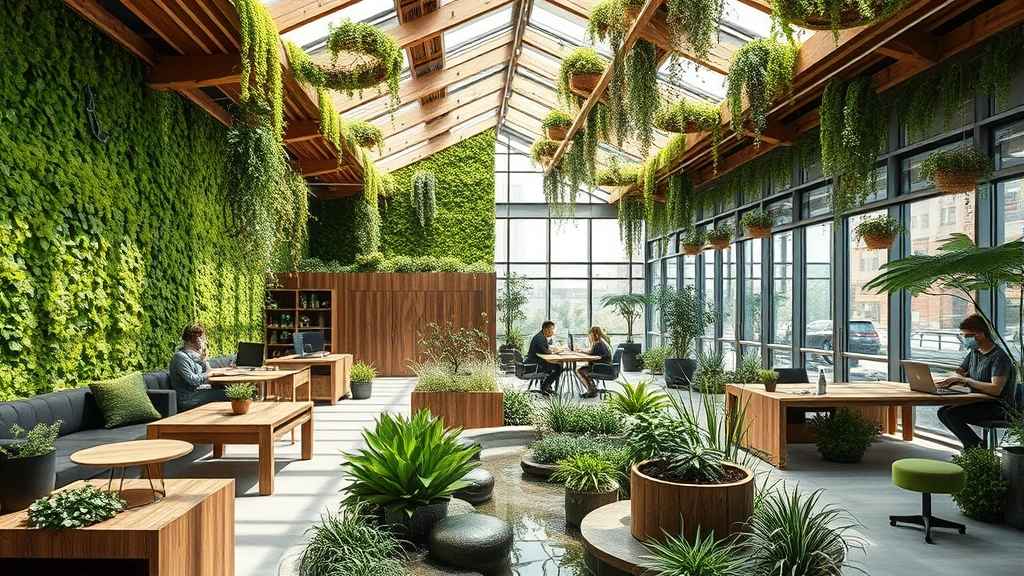
” alt=”Sustainable office workspace featuring living green walls, natural materials, recycled wood furniture, and employees working in collaborative zones with plants throughout the space”>
Case Studies of Excellence
Multiple organizations have successfully implemented balanced work ecosystem principles, demonstrating measurable improvements across performance and sustainability dimensions.
Tech Company Transformation: A mid-sized software company implemented comprehensive workplace redesign incorporating natural light optimization, acoustic privacy improvements, and flexible thermal control. They simultaneously restructured work practices to allow remote work flexibility and established psychological safety protocols. Within two years, they reported 35 percent productivity improvement, 45 percent reduction in turnover, and 28 percent energy cost reduction. Employee engagement scores increased from 52 percent to 78 percent.
Manufacturing Facility Redesign: An industrial company applied ecosystem principles to factory floor operations, improving ventilation, lighting, and acoustic environments while establishing peer-led continuous improvement teams. They implemented resource efficiency programs reducing waste by 60 percent and energy consumption by 33 percent. Worker safety incidents decreased 70 percent, and production quality improved 22 percent.
Professional Services Integration: A consulting firm redesigned their office ecosystem to support hybrid work, incorporating activity-based working principles with spaces optimized for different work types. They established communication protocols preventing always-on expectations and created community-building practices for distributed teams. Consultant retention improved from 68 percent to 82 percent, and client satisfaction scores increased notably.
These cases demonstrate that balanced work ecosystem creation requires sustained commitment and integrated approaches addressing all dimensions simultaneously. Organizations achieving excellence report competitive advantages extending across talent attraction, operational efficiency, innovation capacity, and brand reputation. Explore more insights through our comprehensive blog collection on related topics.
FAQ
What is a balanced work ecosystem?
A balanced work ecosystem integrates physical environmental quality, healthy social dynamics, sustainable resource management, and strategic technology use to create workplaces where employees thrive while organizations achieve superior performance. It applies ecological principles to organizational design, recognizing that diverse, interconnected systems function more effectively than isolated components.
How does environmental quality affect work performance?
Physical environmental factors—air quality, lighting, acoustics, and temperature—directly influence cognitive function, focus capacity, creativity, and physical health. Poor environmental quality reduces productivity by 15-25 percent and increases absenteeism and healthcare costs. Optimized environments enhance decision-making, attention span, and innovation.
Can remote work support ecosystem balance?
Yes, when properly implemented. Remote work flexibility improves work-life balance, reduces commuting environmental impact, and expands talent pools. However, success requires intentional communication structures, opportunities for connection, clear boundary-setting regarding availability, and technology infrastructure supporting both collaboration and individual focus.
How do organizations measure ecosystem health?
Comprehensive measurement includes employee engagement surveys, productivity and quality metrics, health outcome tracking, retention rates, environmental performance indicators, and innovation capacity assessment. Organizations typically combine quantitative metrics with qualitative feedback to understand ecosystem dynamics comprehensively.
What budget allocation supports ecosystem improvement?
Initial investments in environmental upgrades, technology infrastructure, and program development typically represent 2-5 percent of operational budgets. However, return on investment typically appears within 18-36 months through productivity gains, reduced turnover, lower healthcare costs, and improved customer satisfaction. Long-term cost savings often exceed 20-30 percent compared to organizations neglecting ecosystem design.
How can smaller organizations create balanced work ecosystems?
Balanced ecosystems don’t require unlimited resources; they require strategic prioritization. Smaller organizations often succeed by starting with high-impact interventions like improving air quality and lighting, establishing psychological safety practices, and implementing flexible work arrangements. Incremental improvements addressing one ecosystem dimension at a time eventually create comprehensive balance.


