
How Ecosystem Services Impact GDP: A Deep Dive into Nature-Based Economic Solutions
The relationship between ecological health and economic prosperity has long been underestimated in traditional GDP calculations. Recent comprehensive studies reveal that ecosystem services—the tangible benefits nature provides to human economies—contribute trillions of dollars annually to global economic output. From pollination services worth hundreds of billions to carbon sequestration preventing catastrophic climate costs, natural systems function as invisible economic engines that sustain modern commerce and human welfare.
This analysis explores the quantifiable economic value of biodiversity, the mechanisms through which environmental systems support economic growth, and why policymakers increasingly recognize that nature conservation represents sound fiscal policy rather than merely environmental sentiment. Understanding these connections fundamentally reshapes how we evaluate development priorities and investment strategies.
Understanding Ecosystem Services and Economic Value
Ecosystem services represent the myriad ways natural systems generate economic value. These services fall into four primary categories: provisioning services (food, water, raw materials), regulating services (climate regulation, water purification, pollination), supporting services (nutrient cycling, habitat provision), and cultural services (recreation, spiritual value, aesthetic appreciation).
The economic significance of these services becomes apparent when examining specific examples. Agricultural pollination alone—performed primarily by wild insects and managed honeybees—generates approximately $15-20 billion annually in crop value across global markets. Without this ecosystem service, food production would require expensive artificial pollination methods or would collapse entirely for many crops. Similarly, human-environment interactions demonstrate how wetlands provide water filtration worth billions in avoided water treatment costs, while mangrove forests protect coastal communities from storms while simultaneously supporting fisheries worth billions in economic output.
The World Bank’s comprehensive assessments indicate that nature-based solutions addressing climate adaptation and mitigation could deliver $7.1 trillion in net economic benefits through 2030 when accounting for avoided climate damages, improved health outcomes, and enhanced productivity. These figures fundamentally challenge the outdated notion that environmental protection conflicts with economic growth.
Traditional GDP metrics have historically excluded or undervalued ecosystem services, creating perverse incentives that treat natural capital depletion as economic gain. When a forest is logged, GDP increases despite permanent loss of productive natural assets. This accounting failure has contributed to systematic ecological degradation that ultimately undermines long-term economic stability.
Quantifying Nature’s Contribution to Global GDP
Recent methodological advances in environmental accounting enable more precise quantification of ecosystem services’ economic contribution. Research published through the United Nations Environment Programme estimates that ecosystem services contribute approximately $125 trillion annually to global economic welfare—substantially exceeding global GDP of approximately $100 trillion. This disparity illustrates how profoundly undervalued natural capital remains in conventional economic analysis.
Breaking down specific sectors reveals the magnitude of nature’s economic contribution:
- Carbon sequestration services prevent climate damages estimated at $500 billion to $2 trillion annually depending on carbon pricing assumptions
- Freshwater provision and purification support economic activities worth approximately $70 billion yearly while avoiding water treatment infrastructure costs
- Soil formation and nutrient cycling enable agriculture generating $1.3 trillion in annual output, with natural soil processes providing $40-50 billion in annual value
- Fishery support services maintain aquatic ecosystems generating $150-200 billion in commercial catch value plus subsistence fishing for 3+ billion people
- Pollination services support crops accounting for 35% of global food production by weight
These valuations employ established environmental economics methodologies including contingent valuation, hedonic pricing, replacement cost analysis, and benefit transfer approaches. While acknowledging measurement limitations, these estimates provide orders-of-magnitude understanding of ecosystem services’ economic significance.
The economic losses from ecosystem degradation compound rapidly. World Bank analyses document that biodiversity loss and ecosystem degradation cost the global economy approximately $2-5 trillion annually in lost ecosystem services, with rates of loss accelerating. Tropical forest loss alone represents approximately $2-5 trillion in lost economic value when accounting for carbon storage, watershed services, and biodiversity value.
Nature-Based Solutions as Economic Catalysts
Nature-based solutions (NBS)—interventions that harness ecological processes to address environmental challenges while generating economic benefits—represent emerging paradigms for sustainable economic development. These approaches contrast with conventional grey infrastructure by leveraging natural systems’ regenerative capacity.
Wetland restoration exemplifies NBS economic potential. Restored wetlands provide flood protection, water filtration, carbon sequestration, and habitat provision simultaneously. A single hectare of restored wetland provides ecosystem services worth approximately $5,000-15,000 annually while requiring minimal ongoing maintenance. This contrasts favorably with constructed treatment wetlands or grey infrastructure alternatives requiring perpetual energy inputs and replacement cycles.
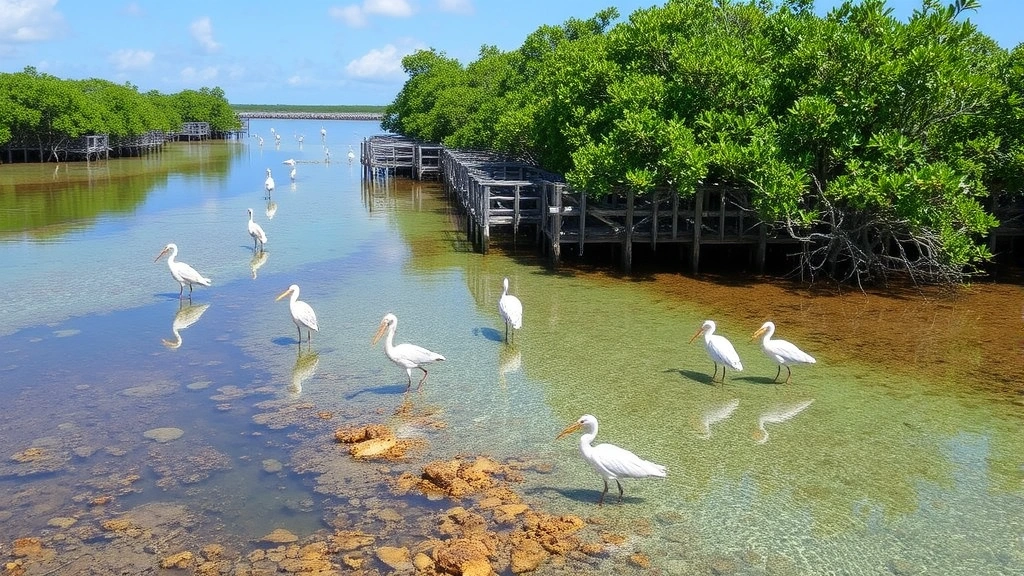
Mangrove conservation and restoration demonstrate particularly compelling economic returns. Mangrove ecosystems provide nursery habitat supporting fisheries worth $1-2 billion annually while protecting coastal infrastructure from storms. The economic value of mangrove storm protection alone exceeds $8 billion annually, yet these forests occupy minimal land area and face ongoing conversion pressure. Investment in mangrove restoration typically generates return on investment within 5-10 years through fishery support and coastal protection benefits.
Carbon sequestration through forest conservation provides additional economic value through emerging carbon markets and climate mitigation benefits. Tropical forest conservation costs approximately $100-300 per hectare annually while providing carbon sequestration services worth $1,000-3,000 per hectare annually at realistic carbon prices. This economic advantage explains accelerating investment in forest conservation through results-based payment mechanisms.
Urban green infrastructure—parks, green roofs, street trees, and restored urban wetlands—generates measurable economic returns through stormwater management, heat reduction, air quality improvement, and property value enhancement. Studies document that strategic urban tree planting reduces cooling costs by 20-30% for adjacent buildings while providing air quality improvements valued at $100-500 per tree annually in reduced health costs.
Circular Economies and Sustainable Growth Models
Circular economy approaches fundamentally restructure economic relationships with natural systems by eliminating waste through regenerative design principles. Rather than extractive linear models (take-make-dispose), circular systems maintain material and nutrient flows within productive cycles, dramatically reducing resource extraction pressure.
The economic case for circular transitions strengthens continuously. The Ellen MacArthur Foundation documents that circular economy adoption could generate net economic benefits of approximately $4.5 trillion by 2030 through resource efficiency, waste elimination, and innovation-driven productivity improvements. These benefits accrue across manufacturing, agriculture, energy, and consumption sectors.
Agricultural circular economy models demonstrate particular promise. Regenerative agriculture practices—crop rotation, cover cropping, integrated livestock, minimal tillage—rebuild soil organic matter while reducing synthetic input costs. Farmers adopting regenerative practices typically experience 20-40% cost reductions within 3-5 years as synthetic fertilizer and pesticide expenses decline while soil productivity increases. Simultaneously, soil carbon sequestration generates carbon credit value of $500-2,000 per hectare annually in emerging markets.
Industrial symbiosis and by-product utilization create economic value from waste streams. Steel and cement industries increasingly incorporate waste materials as inputs, reducing extraction costs while solving waste management challenges. Brewery waste becomes livestock feed; construction demolition materials become aggregate; fish processing waste becomes fertilizer and animal feed. These circular flows reduce environmental impact while improving economic efficiency.
Textile and apparel sectors demonstrate how sustainable practices integrate circular principles profitably. Companies implementing material recycling, durability-focused design, and take-back programs reduce raw material costs while commanding price premiums in growing consumer segments valuing sustainability. Fast fashion’s linear model generates $92 billion in annual waste while circular approaches create value recovery opportunities worth billions.
Investment Opportunities in Green Infrastructure
Capital markets increasingly recognize green infrastructure investments as economically competitive opportunities offering both financial returns and ecosystem benefits. Global green bonds exceeded $500 billion in 2021 and continue accelerating as investors recognize the superior risk-adjusted returns of sustainable infrastructure.
Renewable energy investments exemplify this transition. Renewable energy deployment now represents the largest new electricity generation capacity globally, driven entirely by economic competitiveness rather than subsidies in most markets. Solar and wind power generation costs have declined 90% and 70% respectively over the past decade, making these technologies cheaper than coal and gas in most locations. Beyond direct generation economics, renewable infrastructure avoids health costs from air pollution (valued at $100-300 billion annually in avoided mortality and illness) and climate damages worth trillions.
Nature-based climate solutions represent undervalued investment opportunities. Forest conservation, reforestation, wetland restoration, and agricultural soil carbon sequestration can deliver climate mitigation at costs of $10-100 per ton CO2 equivalent—substantially cheaper than most technological alternatives. Yet these approaches receive less than 3% of climate finance despite offering superior cost-effectiveness.
Water infrastructure investment generates compelling returns. Watershed protection through forest conservation costs approximately $50-200 per hectare annually while providing water supply value of $500-2,000 per hectare annually. Cities including New York and Los Angeles invested in watershed protection rather than conventional treatment infrastructure, achieving superior economics while providing co-benefits including recreation, biodiversity, and climate resilience.
Coastal protection through ecosystem restoration offers economically superior alternatives to grey infrastructure. Oyster reef restoration costs approximately $100,000-500,000 per linear kilometer while providing storm protection, water filtration, and fishery support. Conventional seawalls cost $1-5 million per kilometer, require perpetual maintenance, and provide only storm protection without ecosystem co-benefits.
Challenges in Monetizing Ecological Value
Despite compelling economic cases for ecosystem conservation and nature-based solutions, significant barriers impede optimal investment. Monetizing ecosystem services involves complex methodological, institutional, and distributional challenges.
Valuation methodology limitations remain substantial. Non-market valuation techniques rely on assumptions about human preferences, willingness-to-pay, and substitutability that may not reflect true ecological or social values. Contingent valuation methods depend on hypothetical choices that may not correspond to revealed preferences. Replacement cost approaches assume perfect substitutability between natural and human-made systems, which often misrepresents ecological relationships. These limitations require transparent acknowledgment rather than false precision claims.
Distribution of ecosystem service benefits and costs creates political economy challenges. Ecosystem services often benefit broad populations while conservation costs concentrate on specific communities. Tropical forest conservation benefits global climate while imposing opportunity costs on forest-adjacent communities. Payment for ecosystem services schemes must address these distributional concerns to achieve political viability and ethical legitimacy.
Temporal discounting biases economic analysis toward short-term extraction over long-term stewardship. Conventional discounting techniques systematically undervalue future ecosystem service streams, making conservation economically inferior to degradation when evaluated through standard financial analysis. Implementing lower discount rates for environmental assets or alternative valuation approaches that recognize intergenerational equity concerns produces more sustainable policy recommendations.
Institutional fragmentation impedes ecosystem service valuation and payment. Ecosystem services span multiple jurisdictions and sectors, creating coordination challenges. Watershed services cross political boundaries; pollination services span agricultural and wild lands; carbon sequestration involves forestry, agriculture, and energy sectors. Institutional frameworks enabling cross-sector and cross-jurisdictional payment mechanisms remain underdeveloped.
Information asymmetries and market failures prevent efficient ecosystem service valuation. Most ecosystem services lack market prices, creating systematic undervaluation. Externalities—climate damages, air pollution, water contamination—remain unpriced, distorting economic signals. Addressing these market failures requires policy intervention including carbon pricing, pollutant taxes, biodiversity impact assessments, and ecosystem service accounting integration into national accounts.
The Food and Agriculture Organization and ecological economics research increasingly address these challenges through methodological refinement, institutional innovation, and policy integration. Natural capital accounting approaches integrating ecosystem services into national accounts gain adoption among forward-looking governments. Ecosystem service payment mechanisms expand, though typically at scales below optimal levels.

FAQ
What are the primary ecosystem services contributing most to global GDP?
Carbon sequestration, pollination, water provision and filtration, soil formation, and climate regulation provide the largest economic value. These services collectively represent trillions in annual economic benefit, though significant variation exists across regions and ecosystems. Tropical forests provide disproportionately large climate regulation and biodiversity support services, while agricultural regions depend heavily on pollination and soil services.
How do nature-based solutions compare economically to conventional infrastructure?
Nature-based solutions typically offer superior lifetime economics compared to grey infrastructure while providing additional co-benefits. Wetland restoration costs less than constructed treatment systems while providing flood protection, carbon sequestration, and habitat value. Mangrove conservation provides storm protection at lower cost than seawalls while supporting fisheries. However, upfront capital requirements and longer benefit realization timelines sometimes challenge financing, despite superior lifetime value.
Can circular economy models achieve economic growth without environmental degradation?
Circular economy evidence indicates that decoupling economic growth from material throughput and environmental impact is technically feasible and economically advantageous. Reduced resource extraction, waste elimination, and efficiency improvements generate net economic benefits. However, achieving true circular systems requires systemic changes including product design transformation, business model innovation, and consumption pattern shifts. Partial circular transitions remain insufficient for sustainability targets.
What policy mechanisms best incentivize ecosystem service valuation?
Evidence supports policy portfolios combining multiple mechanisms: carbon pricing reflecting climate damages, biodiversity impact assessments and offsetting requirements, natural capital accounting integration into national accounts, payment for ecosystem services programs, and regulatory standards protecting critical ecosystems. No single mechanism proves sufficient; effectiveness requires complementary policy approaches adapted to local contexts and institutional capacities.
How do we address distributional concerns in ecosystem service valuation?
Equitable ecosystem service distribution requires explicit attention to benefit-cost allocation, community participation in valuation and payment design, and rights recognition for indigenous and local communities. Payment for ecosystem services schemes increasingly incorporate benefit-sharing mechanisms and community governance. However, power asymmetries often prevent equitable distribution without strong institutional frameworks and political commitment to justice principles.
What data gaps limit ecosystem service quantification?
Substantial data limitations impede precise ecosystem service valuation. Limited long-term ecological monitoring data constrains understanding of service provision dynamics and resilience thresholds. Spatial variation in service provision remains poorly characterized for many ecosystems. Market price data for ecosystem services remains sparse, limiting valuation. Addressing these gaps requires sustained investment in ecological monitoring networks, remote sensing capabilities, and economic data collection integrated with ecological science.


