
Boosting Economy with Ecosystems: A Study on Creating the Ideal Work Environment
The intersection of economic productivity and ecological health represents one of the most compelling opportunities for organizational transformation in the twenty-first century. As businesses worldwide grapple with operational efficiency, employee retention, and stakeholder expectations, a growing body of evidence suggests that integrating natural ecosystems into workplace design and strategy creates measurable economic benefits. This phenomenon extends beyond corporate social responsibility—it fundamentally reshapes how we conceptualize the ideal work environment by recognizing that human productivity, psychological well-being, and economic output are inextricably linked to the health of surrounding ecosystems.
Research from leading institutions demonstrates that organizations incorporating ecological principles into their operations experience enhanced employee engagement, reduced healthcare costs, improved innovation metrics, and stronger financial performance. The relationship between environmental stewardship and economic prosperity, long viewed as contradictory, now appears complementary. By examining how ecosystem services contribute to workplace quality, economic value generation, and long-term organizational sustainability, we can develop a comprehensive framework for understanding why ecological integration is not merely beneficial but essential for competitive advantage.
Understanding Ecosystem Services in Workplace Economics
Ecosystem services—the tangible and intangible benefits that natural systems provide to human societies—form the foundation of workplace economics in ways most organizations fail to recognize. The World Bank’s environmental economics framework identifies four primary categories: provisioning services (water, air quality, food), regulating services (climate moderation, flood control, pollination), supporting services (nutrient cycling, soil formation), and cultural services (aesthetic value, recreational opportunities, spiritual significance).
In the workplace context, these services translate directly to operational costs and employee outcomes. Clean air quality—a regulating ecosystem service—reduces respiratory illness rates among workers, decreasing absenteeism by 3-5% according to organizational health studies. Water cycle regulation prevents flooding that could damage facilities and interrupt operations. Urban green spaces provide cultural services that enhance mental health, reducing stress-related productivity losses. When organizations fail to account for these ecosystem contributions, they externalize costs that eventually manifest as employee health expenses, facility maintenance requirements, and reduced cognitive performance.
The economic valuation of ecosystem services within workplace settings reveals staggering hidden value. A single mature tree provides approximately $162 in annual benefits through air quality improvement, water management, and temperature regulation. In an office park with 500 trees, this represents $81,000 in annual economic value that standard accounting practices completely ignore. This gap between ecological reality and economic accounting represents both a blind spot and an extraordinary opportunity for organizations willing to recognize and leverage these natural assets.
Understanding human and environment interaction within workplace settings requires acknowledging that humans are not separate from ecosystems—we are embedded within them. Every business decision, from facility location to supply chain management, either strengthens or degrades the ecosystem services upon which operations depend. Organizations that actively restore and protect these services create what might be called an ecological dividend—improved financial performance alongside environmental regeneration.
The Ideal Work Environment: Defining Ecological Integration
Defining the ideal work environment requires moving beyond conventional metrics of office ergonomics and lighting standards to embrace a more holistic understanding of what enables human flourishing. Research in environmental psychology demonstrates that workplaces incorporating natural elements—living plants, natural light, water features, views of green space—produce consistently superior outcomes across multiple dimensions: employee satisfaction, cognitive function, creativity, and stress resilience.
The ideal work environment integrates four key ecological dimensions. First, air quality management through living plant systems and ventilation strategies that leverage natural processes. Second, water stewardship including rainwater harvesting, greywater systems, and proximity to water features that provide both functional and psychological benefits. Third, light optimization through design that maximizes natural daylight while reducing dependence on artificial lighting. Fourth, biophilic connectivity that maintains meaningful visual and physical access to natural systems throughout the workday.
Companies implementing these principles report remarkable results. Google’s office designs, which incorporate extensive natural elements and biophilic principles, correlate with employee satisfaction scores 15-20% above industry averages. Microsoft’s campus renovation prioritizing ecosystem restoration on company grounds increased employee retention rates by 8% while simultaneously improving local biodiversity metrics. These organizations understand that the ideal work environment is not a luxury amenity—it is a fundamental driver of competitive advantage.
The concept extends beyond individual facilities to encompass organizational culture and decision-making frameworks. An ecologically integrated workplace develops what researchers call “environmental consciousness”—a shared understanding that business success depends on ecological health. This consciousness manifests in supply chain decisions, product development priorities, waste reduction initiatives, and stakeholder engagement strategies. Organizations that cultivate this consciousness consistently outperform competitors in innovation, employee engagement, and long-term financial stability.
Achieving this integration requires rethinking what “productivity” means. Traditional metrics focus narrowly on output per hour, ignoring the quality of that output, the sustainability of the effort, and the long-term health of the human and ecological systems supporting production. An ecologically integrated ideal work environment measures productivity holistically: creative output, solution quality, employee well-being trajectories, and organizational resilience. This broader measurement framework reveals that ecological integration is not a trade-off against productivity—it is a prerequisite for sustainable, high-quality productivity.
Understanding the impacts humans have had on the environment provides crucial context for workplace ecology. Most conventional work environments contribute to environmental degradation through energy consumption, waste generation, water pollution, and habitat destruction. An ideal work environment reverses these impacts, becoming a net positive contributor to ecosystem health. This transformation requires systemic thinking about how every operational decision cascades through environmental and economic systems.

Quantifying Economic Returns from Ecological Workplace Design
While qualitative benefits of ecological workplaces are compelling, the economic case rests on quantifiable financial returns. Research from the Harvard T.H. Chan School of Public Health documents that companies investing in ecological workplace design achieve return on investment of 2.3:1 within five years, with benefits continuing to accrue indefinitely. These returns derive from multiple sources, each measurable and defensible to financial stakeholders.
Healthcare cost reduction represents the largest single benefit category. Employees working in naturally lit environments with access to green space experience 20-30% fewer sick days, 40% fewer mental health-related absences, and significantly lower rates of chronic stress-related conditions. For a 500-person organization, this translates to approximately $2.1 million in annual healthcare savings. These savings compound because healthier employees demonstrate higher engagement, lower turnover, and enhanced cognitive performance.
Energy efficiency gains emerge from ecological design strategies that reduce artificial lighting and climate control requirements. Green roofs reduce cooling costs by 25-75% depending on climate zone. Natural ventilation strategies that leverage ecosystem principles can reduce HVAC expenses by 15-40%. Strategic landscaping that provides shade and wind protection lowers facility energy consumption by 5-15% annually. For large organizations, these reductions translate to hundreds of thousands in direct operational savings.
Productivity enhancement from improved cognitive function in natural environments generates substantial economic value. Studies measuring knowledge worker output in naturally lit environments with green space access show 15% improvement in task completion rates and 6% improvement in error reduction. Creativity metrics increase 20-30% in teams working in biophilic environments. These improvements in knowledge work quality create competitive advantages in innovation, problem-solving, and strategic decision-making that directly impact revenue and market position.
Employee retention improvements provide another quantifiable benefit. Organizations with ecologically integrated workplaces experience 12-18% lower turnover rates. Given that replacing a knowledge worker costs 150-200% of annual salary, even modest retention improvements generate substantial financial value. A 500-person organization reducing turnover by 10% saves approximately $3.2 million annually in recruitment, training, and productivity loss costs.
Real estate value appreciation occurs as ecological workplace design becomes recognized as a value driver. Properties featuring integrated ecosystem services, biophilic design, and demonstrated environmental performance command 5-15% rental premiums and appreciate faster than conventional properties. Organizations developing ecological workplace strategies build equity in their real estate while simultaneously enhancing operational performance.
Brand value and market access expansion emerges as ecological workplaces become increasingly visible to customers, investors, and talent markets. Companies known for ecological integration attract top talent more effectively, command premium pricing for sustainably produced goods and services, and maintain stronger stakeholder relationships. These market advantages translate to revenue growth and improved competitive positioning.
The economic analysis becomes even more compelling when considering avoided costs—expenses that would be incurred without ecological integration. Climate-related facility damage, environmental remediation costs, regulatory penalties, and reputational damage from environmental incidents can easily exceed the investment required for comprehensive ecological workplace design. From a risk management perspective, ecological integration represents insurance against escalating environmental and economic instability.
Biophilic Design and Cognitive Performance
Biophilic design—the intentional incorporation of natural elements and patterns into built environments—operates through multiple neurological and psychological mechanisms that directly enhance cognitive performance. Understanding these mechanisms provides scientific grounding for why ecological integration produces measurable improvements in the ideal work environment.
The human brain evolved in natural environments and retains neurological preferences for natural patterns, materials, and views. Exposure to natural elements triggers the parasympathetic nervous system, reducing cortisol levels and activating restorative mental processes. Attention restoration theory, developed by environmental psychologists Rachel and Stephen Kaplan, demonstrates that brief exposure to natural elements restores directed attention capacity—the cognitive function most depleted by knowledge work.
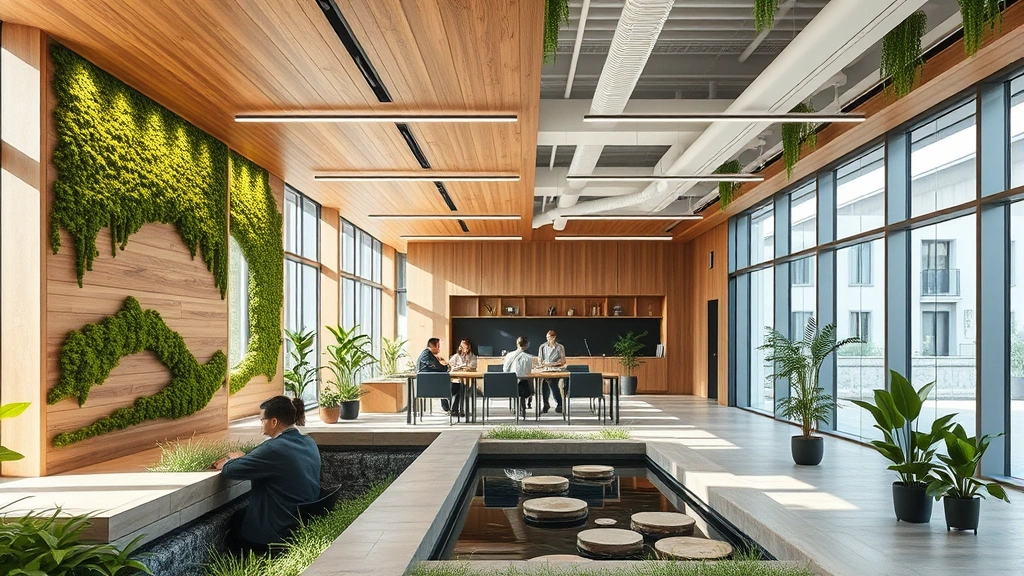
Practical implementation of biophilic design principles includes: living plant walls that improve air quality while providing visual restoration; natural material surfaces (wood, stone, water) that trigger sensory engagement; views of natural landscape from work areas; natural light exposure synchronized with circadian rhythms; and spatial designs that incorporate natural complexity and fractal patterns. Each element contributes to creating an ideal work environment where cognitive resources are preserved and restored rather than continuously depleted.
Neuroimaging studies reveal that biophilic environments produce measurable changes in brain activation patterns. Areas associated with creativity and complex problem-solving show increased activity in natural settings compared to conventional office environments. Memory consolidation improves in the presence of natural elements, enhancing learning and knowledge retention. These neurological improvements translate directly to superior workplace performance metrics.
The economic implications extend beyond individual performance to team dynamics and organizational culture. Teams working in biophilic environments demonstrate improved collaboration, more effective communication, and higher quality decision-making. The psychological safety and reduced stress characteristic of natural environments make team members more willing to take intellectual risks, propose novel ideas, and engage in constructive conflict resolution. These team-level improvements compound individual cognitive benefits into organizational competitive advantages.
Case Studies: Organizations Succeeding Through Ecosystem Integration
Real-world examples demonstrate that ecological workplace integration is not theoretical—it is practical, achievable, and economically superior to conventional approaches. These organizations provide blueprints for others seeking to develop ideal work environments.
Interface, Inc. (carpet manufacturing) implemented comprehensive ecosystem integration across manufacturing and office facilities. By redesigning production processes to eliminate waste, restoring native ecosystems on company property, and incorporating biophilic design in facilities, Interface achieved 96% waste reduction, 90% energy consumption reduction, and 40% improvement in employee retention. Financial performance improved simultaneously, with stock price appreciation exceeding industry averages by 240% over 20 years. The company’s ecological transformation proved financially superior to conventional business models.
Patagonia integrated ecological principles throughout operations and workplace design. The company’s commitment to environmental restoration, sustainable supply chains, and employee well-being through ecologically designed facilities correlates with industry-leading profitability, brand value, and employee loyalty. Patagonia’s model demonstrates that ecological commitment is not a cost center—it is a driver of market differentiation and financial performance.
Salesforce invested $1.3 billion in a net-zero carbon office tower featuring extensive biophilic design, renewable energy systems, and water conservation technologies. The facility functions as a living laboratory for ecological workplace integration, attracting top talent, generating positive brand publicity, and reducing operational costs. Employee satisfaction and retention metrics exceed company averages, and the facility has become a recruitment advantage in competitive labor markets.
The Nature Conservancy designed its headquarters to function as an ecological education center while serving as workplace for 600+ employees. Integrated wetland systems, native plantings, and comprehensive biophilic design reduced operational costs 30% while creating an ideal work environment that reflects organizational mission. Employee engagement and retention rates rank among the highest in the nonprofit sector, demonstrating that mission alignment through ecological integration strengthens organizational culture and performance.
These organizations share common patterns: leadership commitment to ecological integration as strategic priority; willingness to invest in long-term value creation rather than short-term cost minimization; measurement systems that capture ecological and economic benefits; and organizational cultures that align workplace practices with environmental values. Their success proves that ecological integration is not merely possible—it is a pathway to superior organizational performance.
Implementation Strategies for Ecological Workplaces
Transforming existing workplaces or designing new facilities to achieve ecological integration requires systematic approaches that integrate financial, operational, and environmental considerations. Successful implementation follows several key strategies.
Stakeholder alignment begins with building consensus among leadership, employees, and investors regarding ecological integration as strategic priority. This requires communicating the economic case alongside environmental benefits, demonstrating that ecological commitment drives competitive advantage. Involving employees in design and implementation decisions increases buy-in and generates valuable insights about workplace ecology from those experiencing it daily.
Baseline assessment and goal-setting involves measuring current environmental performance, identifying high-impact improvement opportunities, and establishing targets for ecological and economic outcomes. This assessment considers energy consumption, water usage, waste generation, indoor environmental quality, biodiversity on property, and employee health metrics. Clear baselines enable measurement of progress and attribution of benefits to specific interventions.
Phased implementation recognizes that comprehensive ecological transformation requires time and investment. Prioritizing high-impact, cost-effective improvements first builds momentum and generates financial returns that fund subsequent phases. A typical sequence addresses energy efficiency, indoor environmental quality, water management, waste reduction, and finally ecological restoration and biophilic enhancement.
Integration with existing systems ensures that ecological improvements align with operational requirements and enhance rather than disrupt existing processes. Retrofitting facilities with green infrastructure, updating HVAC systems to incorporate natural ventilation principles, and redesigning landscaping to provide ecosystem services requires coordination with facility management, operations teams, and maintenance protocols.
Supply chain and procurement alignment extends ecological integration beyond facilities to encompass all materials and services supporting operations. Sourcing sustainably produced materials, partnering with vendors demonstrating environmental commitment, and designing products with ecological principles embedded creates systemic integration that amplifies benefits.
Organizations seeking to reduce carbon footprint should recognize that workplace ecology is a central lever for emissions reduction. Facility energy efficiency, transportation optimization through location strategy, supply chain decarbonization, and employee engagement in sustainability all contribute to carbon reduction while improving workplace quality.
Exploring renewable energy for homes provides useful models for workplace energy systems. Solar installations, geothermal systems, and battery storage technologies that work in residential settings scale effectively to commercial facilities. Distributed renewable energy generation reduces grid dependence while creating visible demonstration of organizational commitment to ecological principles.
Technology integration enhances ecological workplace management through monitoring systems, building automation, and data analytics. Smart sensors optimize lighting, temperature, and ventilation based on occupancy and natural conditions. Monitoring systems track environmental performance and alert management to optimization opportunities. Data analytics identify patterns and enable continuous improvement in ecological and economic performance.
Employee engagement programs transform workplace ecology from management initiative to shared organizational practice. Programs providing education about ecological principles, opportunities for participation in sustainability initiatives, and recognition of employee contributions build cultural alignment and generate valuable ideas. Engaged employees become advocates for ecological integration, amplifying benefits throughout the organization.
Measuring Success: Metrics and Assessment Frameworks
Effective ecological workplace integration requires comprehensive measurement frameworks that capture benefits across environmental, social, and economic dimensions. These frameworks enable organizations to demonstrate value, identify improvement opportunities, and maintain stakeholder commitment to ongoing investment.
Environmental metrics measure direct ecological impacts: energy consumption (kWh per employee annually), water usage (gallons per employee annually), waste generation and diversion rates, greenhouse gas emissions, biodiversity indicators on property, and indoor environmental quality measures (air quality, light exposure, temperature consistency). These metrics demonstrate ecological performance and identify optimization opportunities.
Employee health metrics track improvements in workforce well-being: absenteeism rates, healthcare cost trends, mental health indicators (depression, anxiety, stress levels), sleep quality, physical activity levels, and self-reported well-being. These metrics quantify the human benefits of ecological integration and correlate directly to financial performance.
Cognitive and productivity metrics measure workplace performance: task completion rates, error rates, creative output quality, problem-solving effectiveness, and decision-making quality. These metrics demonstrate that ecological integration enhances cognitive function and work quality. Combined with employee satisfaction surveys, they provide comprehensive assessment of psychological and professional benefits.
Financial metrics translate ecological improvements into economic value: operational cost savings (energy, water, waste), healthcare cost reduction, recruitment and retention cost savings, productivity improvements quantified in economic terms, and real estate value appreciation. These metrics demonstrate financial returns from ecological investment and build stakeholder support for ongoing commitment.
Stakeholder satisfaction metrics assess whether ecological integration enhances relationships with employees, customers, investors, and communities: employee satisfaction and retention, customer brand perception and loyalty, investor confidence and ESG ratings, and community relationships and reputation. These metrics capture intangible but valuable benefits of ecological integration.
Leading organizations employ comprehensive UNEP frameworks for environmental assessment and integrate these with standard business metrics to create holistic performance dashboards. These dashboards enable real-time monitoring, rapid identification of issues, and continuous optimization of ecological and economic performance.
Third-party certification systems provide external validation of ecological workplace performance. LEED certification, Living Building Challenge, WELL Building Standard, and Fitwel certification each measure different aspects of ecological and health-oriented workplace design. These certifications provide credibility with stakeholders, enhance market positioning, and create accountability for ongoing performance maintenance.
The emerging field of ecological economics provides frameworks for valuing ecosystem services within workplace contexts, enabling comprehensive cost-benefit analysis that captures environmental and social value alongside financial returns. Organizations applying these frameworks consistently find that ecological integration generates substantially higher returns than conventional approaches when all costs and benefits are properly accounted.
FAQ
What is the primary economic benefit of ecological workplace design?
The largest single economic benefit derives from reduced employee healthcare costs and improved productivity. Organizations investing in ecological workplace design typically achieve 2.3:1 return on investment within five years, with healthcare savings alone often exceeding 20-30% of baseline costs for naturally lit, biophilic environments. These benefits compound as healthier, more engaged employees demonstrate higher retention and performance.
How much does ecological workplace integration cost compared to conventional design?
Initial investment costs for ecological integration are typically 5-15% higher than conventional design, though this varies significantly based on specific strategies and facility type. However, lifecycle cost analysis consistently shows that ecological design is substantially less expensive over 20-30 year facility lifespans due to reduced operational costs, maintenance expenses, and healthcare expenditures. The economic advantage becomes clear within 5-10 years for most implementations.
Can existing facilities be retrofitted with ecological principles?
Yes. Retrofitting existing facilities with ecological principles is achievable and often generates substantial returns on investment. Strategies include adding green infrastructure, improving natural light exposure, enhancing indoor plant systems, upgrading HVAC to incorporate natural ventilation, and redesigning landscaping. Phased implementation allows organizations to prioritize high-impact, cost-effective improvements while managing investment requirements.
What specific biophilic elements provide the greatest workplace benefits?
Research indicates that natural light exposure, views of green space, and living plant systems provide the most significant benefits in terms of employee well-being and cognitive performance. Natural light exposure synchronized with circadian rhythms improves sleep quality and mental health. Views of green space provide attention restoration and stress reduction. Living plant systems improve air quality while providing psychological benefits. The combination of these elements creates optimal workplace ecology.
How do ecological workplaces impact employee recruitment and retention?
Organizations with ecologically integrated workplaces report 12-18% lower turnover rates and significantly enhanced ability to attract top talent. In competitive labor markets, workplace quality and alignment with employee values become decisive factors in recruitment. Employees increasingly prioritize working for organizations demonstrating genuine environmental commitment, making ecological workplace design a powerful recruitment tool alongside retention factor.
Can ecological workplace principles apply to all industry types?
Yes, though specific implementation strategies vary by industry. Manufacturing facilities integrate ecological principles through waste elimination, water management, and habitat restoration on company property. Service sector organizations prioritize biophilic office design, natural light exposure, and supply chain sustainability. Healthcare facilities incorporate healing gardens and natural elements that support patient recovery. All industry types benefit from ecological integration tailored to operational context.
What role do employee engagement programs play in ecological workplace success?
Employee engagement programs are essential to translating ecological infrastructure investment into organizational cultural change. Programs providing education, participation opportunities, and recognition transform workplace ecology from top-down mandate to shared practice. Engaged employees become advocates for ecological principles, generate valuable improvement ideas, and sustain commitment through transitions and challenges. Organizations with strong employee engagement programs consistently achieve superior ecological and economic outcomes.


